More than ever
Fly control protects profits
In a market where every pound counts more than ever, fly control isn’t an expense—it’s an investment. The key to effective fly control is simple: start early and stay aggressive all season long.
Flies do more than irritate cattle. They cost you profit. Horn flies alone can cut gains by up to 0.2 pound per head, per day. In today’s high-value market, those losses add up fast.
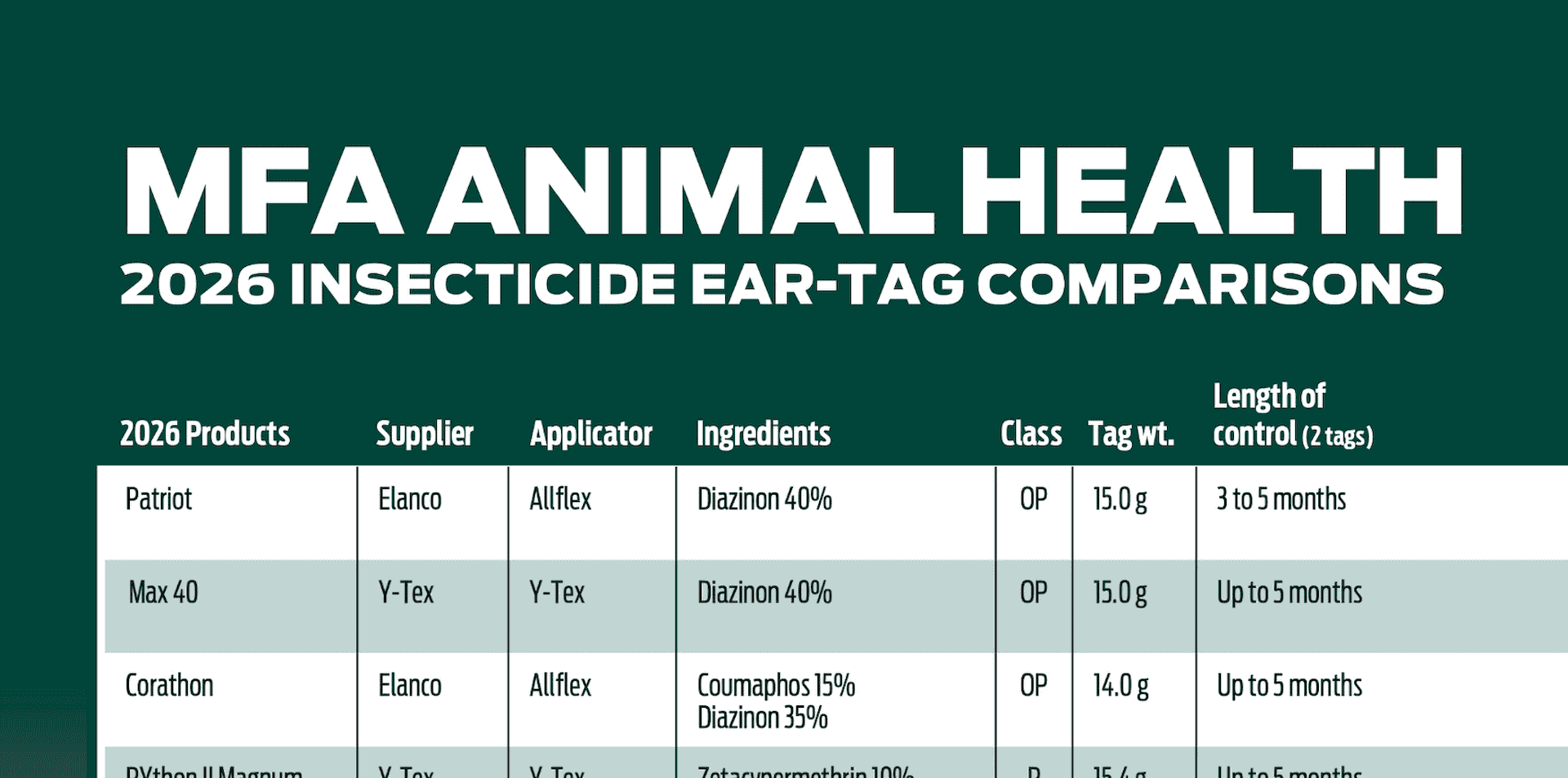
The solution isn’t one product. It’s a plan. Feed Ricochet mineral with insect growth regulators to keep flies from developing. Place insecticide ear tags in late spring to manage flies throughout the summer, and use pour-ons, sprays, dust bags and oilers for added control.
Talk with your MFA solutions provider and build a season-long strategy of fly control to protect performance and profitability.
Flies are a nuisance. They are irritating to cattle, horses, stock dogs and, of course, humans. More concerning, they are also vectors for diseases. An integrated pest management program (IPM) is important to control fly populations. Effective fly management is especially critical in feeding operations and dairies because of their confined nature.
No one practice is sufficient to control flies. Effective IPM plans use a variety of practices and control methods to keep fly populations in check, and these measures should start well before fly season begins. There are four important branches of an IPM program: cultural, chemical, physical, and biological. While each branch is important, the cultural and physical branches are the fundamental components of fly control.
As you implement an IPM plan, monitor its effectiveness. Evaluate fly populations throughout your operation with traps and speck cards. Record which steps are successful and where additional improvement is needed. By carefully evaluating your program, you can make appropriate adjustments as needed.
Cultural practices make a world of difference in fly management. These practices include manure management, regular cleaning of spilled milk and feed, removal of vegetative buildup and soiled or decaying bedding in cattle areas, and landscape maintenance. Removing these breeding sites for flies dramatically reduces their population in a cattle operation. Additional cultural elements also help fly control. These practices include removing tall grasses and weeds, where flies can rest in the plants, regularly cleaning and moving calf hutches and pens, and ensuring that pens are well ventilated.
Most producers are familiar with the conventional chemical fly-control methods, including foggers, baits, perimeter sprays and on-animal treatments. When using these products, remember to rotate active ingredients so flies do not become resistant. Chemical control also includes feed-through insect growth regulators (IGRs). Feed-through products prevent the emergence of adult flies. These products work by delivering an important active ingredient directly to cattle, where it is eventually passed into the animal’s manure. Flies then lay their eggs on the manure, and the IGR interferes with the lifecycle of the fly. This process prevents biting, breeding adult flies from developing out of the eggs laid in the manure.
A common free-choice MFA cattle mineral used for controlling horn flies on pasture cattle is Ricochet Altosid IGR Shield Mineral. Another IGR is Clarifly, with the active ingredient diflubenzuron, which has a label for four species of flies. It is fed to confined cattle and also approved for swine, horses, goats and sheep. Begin feeding these products about a month before flies begin to appear and continue until about a month after the first frost. This program of 30 days on each side of fly season suppresses fly activity early and reduces overwintering pupae. Feed the product to animals of all ages to treat as much manure as possible.
Physical efforts are perhaps the most obvious method of fly control, though it is not always the easiest. Structures and facilities can be designed to deny flies access to locations, or at least make the areas less hospitable for them. Patching or sealing cracks in structures, installing mesh screens over windows, and sealing around electrical outlets can close off entry points for flies. Installing fans that provide a downward and outward air flow reduces fly activity in buildings. Additionally, consider strategically placing non-insecticidal sticky, jug or bag traps to aid these efforts.
Biological control involves harnessing the power of natural predators of flies. Parasitic wasps, predatory mites, predatory beetles and fly pathogens are all used to control flies. These methods interrupt the lifecycle of the fly. For instance, predatory beetles feed on fly larvae found in dung, while parasitic wasps lay their eggs inside fly pupae.
SEARCH PRODUCTS ON MFA CONNECT

Click to search Clarifly products at MFA
***
Click to search Altosid products at MFA
Check out the latest MFA Animal Health 2026 Insecticide Ear-Tag Comparison here:
More than ever, fly control protects profits
A proactive, season-long strategy for managing flies is essential in a high-value cattle market. An integrated pest management (IPM) program with a multi-faceted approach should begin before flies emerge and continue through the entire grazing season.
Read More >Feed your fly control needs
Using a feed-through product with insect growth regulators (IGR) is the easiest, most effective and economical way of controlling horn flies for cattle producers. To achieve optimum fly control, MFA Ricochet products with Altosid or Clarifly should be used in conjunction with other good management and sanitation practices.
Read More >Four key components of effective fly control
Flies are irritating to cattle, horses, stock dogs and, of course, humans. More concerning, they are also vectors for diseases. An integrated pest management program (IPM) is important to control fly populations. Effective fly management is especially critical in feeding operations and dairies because of their confined nature.
Read More >There’s no universal solution for fly control
Many options are available to help manage the three species that economically impact cattle: horn flies, face flies and stable flies. While similar in some ways, each type of fly has characteristics that make its control slightly different from the others.
Read More >