Funding the front line
By Allison Jenkins
MFA grants help volunteer firefighters protect Missouri communities
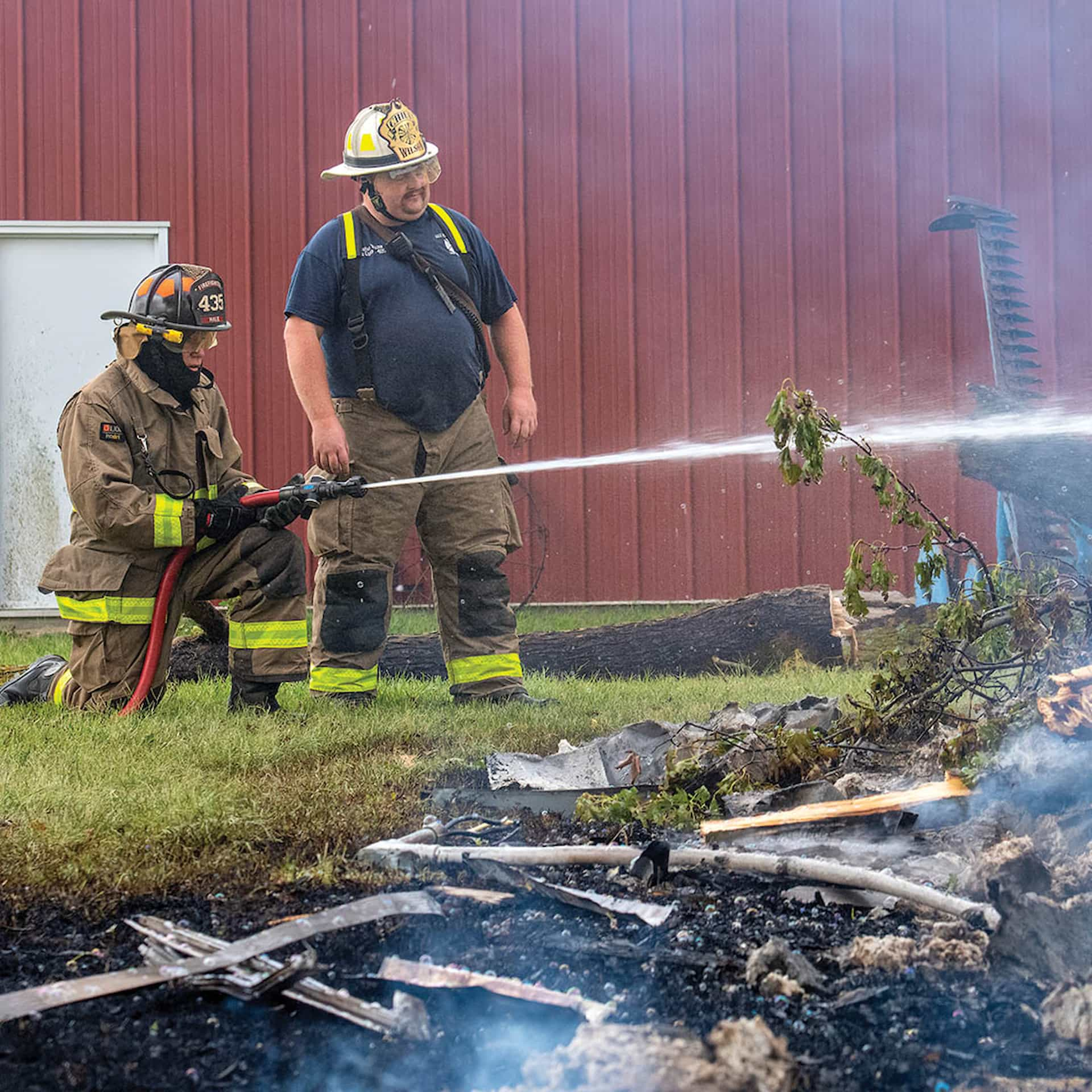
Members of the Hale Fire Protection District intended to spend a recent Saturday morning in a training exercise for prescribed burns. Instead, those plans were interrupted by an early-morning call to extinguish a fire at an abandoned house.
What was supposed to be a day of practice quickly became the real thing. But for Hale’s all-volunteer firefighters, situations like this aren’t unusual.
“It happens,” said Hale Fire Chief Nick Wilson, who also serves as city mayor, school transportation director and bus driver. “You learn to be flexible. There are times when I have to get somebody to drive my bus route because we’re out on a call. Birthdays, Christmas, 24-7, 365 days a year—when that pager goes off, you have to answer.”
 Juggling full-time jobs and responding to emergencies at all hours aren’t the only challenges facing volunteer departments. Making sure firefighters have the necessary equipment and training is another, especially with budgets that are often stretched thin.
That’s why MFA’s Volunteer Fire Department Grant Program has become such an important resource for districts such as Hale. Funded by the MFA Incorporated Charitable Foundation and administered by the University of Missouri Extension Fire and Rescue Training Institute, the program has awarded more than $328,000 in grants since 2019. The application period for 2026 runs throughout October and November.
“Grant funding directly helps us strengthen our ability to serve and protect the community,” Wilson said. “Without that support, critical purchases would not always be possible.”
A two-time recipient of the MFA grant, the Hale Fire Protection District serves roughly 140 square miles across Carroll and Livingston counties. The department’s 14-member roster is on pace to answer nearly 200 calls this year, Wilson said, ranging from structure fires and vehicle accidents to medical emergencies. The crew also provides free support for residents who want to conduct prescribed burns on pastures, fields and woodlands.
Last year, Hale received a $2,000 MFA grant toward the purchase of a Missouri Statewide Interoperability Network (MOSWIN) radio, two-way communication technology that allows local, state and federal public safety agencies to talk to each other across different jurisdictions. A city allocation of $2,500 helped round out the $5,000 price tag of the radio.
“We support six other districts with mutual aid and cover 400 square miles as first responders on medical calls, so the MOSWIN radio will allow us to communicate with any other agency in the network,” Wilson said. “The state keeps pushing for everybody to switch to that technology, and most ambulance districts and sheriff’s offices are on it already. Right now, we’re on conventional VHF channels, which limits us when we need to reach paramedics or help with a big fire outside our district.”
Without the grant help, Wilson said such a purchase would be difficult for the district, which operates on an annual budget of roughly $70,000, mainly funded by taxpayers. Insurance, utilities and fuel consume a significant portion of those dollars before considering equipment expenses, which add up quickly. A set of turnout gear can cost between $3,500 and $5,000, while specialized radios, medical equipment and brush-fire apparatus often cost thousands more.
The challenges are common across Missouri. According to the U.S. Fire Administration, more than 83% of the state’s 755 fire departments are volunteer or mostly volunteer. To operate, they rely on a mix of local taxes, state and federal grants, community fundraising and private donations.
“The money’s always pretty tight, but grants make it go farther,” Wilson said. “If volunteer departments aren’t applying for them, they’re doing a disservice to their communities.”
But grants and equipment are only part of the equation. Rural fire protection ultimately depends on volunteers willing to leave work, family gatherings and sleep to serve the friends, neighbors and family members who depend on them in an emergency.
“I like helping the people you grew up with,” said Ethan Ralls, a Hale volunteer firefighter and full-time paramedic. “Being able to go in on someone’s worst day, knowing what to do to help them, and then seeing them out and about afterward, it’s a great feeling.”
His brother and fellow firefighter, Jason Ralls, said this sense of service along with the close-knit nature of the department keeps volunteers coming back despite long workdays, interrupted schedules and high-pressure situations.
“Helping people, really, that’s the main thing,” he said. “And I like the camaraderie of being part of this crew. Everyone’s got your back.”
That commitment is especially important in communities like Hale, where volunteers often serve as the first line of emergency response.
“Our firefighters may be the only ones who can reach someone in time,” Wilson said. “People could die waiting on an ambulance that has to come from 30 or 45 minutes away. That’s the reality in rural Missouri.”
Programs such as MFA’s Volunteer Fire Department Grant Program help ensure rural first responders can continue providing those vital services. For 2026, the MFA Charitable Foundation board of trustees approved $50,000 for the grant program. The award maximum is $2,000 and minimum is $500.
The application period is open from Oct. 1 through Nov. 30, with award notifications expected after Feb. 1, 2027. Depending on the availability of funds, the goal is to provide grants to at least one recipient in each of the nine Fire Mutual Aid Regions in Missouri. Each agency must be registered with the Missouri Division of Fire Safety.
For more information on the program or instructions on how to apply for grants, visit online at mfa-inc.com/firegrant or email frti@missouri.edu.
Top image cutline: Among members of the all-volunteer Hale Fire Protection District are, from left, Amy Wilson, Chief Nick Wilson, Jason Ralls, Assistant Chief Randy Cooperman, Junior Firefighter Hudson Gilson, Lieutenant Candy Parker, Jim Parker and Ethan Ralls. Mid-story image cutline: Firefighter Jim Parker, left, with support from Chief Nick Wilson, extinguishes the remains of a fire at an abandoned house near Hale.
***
Read MORE FROM THIS ISSUE
Subscribe Today or MFA Incorporated customers/members may request a subscription at their MFA Agri Services location.