The great divide
By Allison Jenkins
FAPRI outlook points to ongoing challenges for crop producers, strong returns in livestock
With the 2026 growing season well underway, tighter margins remain a concern for many crop producers, while cattle operators continue to benefit from historically strong prices, according to the latest U.S. Agricultural Market Outlook from the University of Missouri’s Food and Agricultural Policy Research Institute (FAPRI).
The annual outlook, released in March, paints a divided picture for the farm economy. Elevated input costs and softer commodity prices are expected to keep net returns under pressure for row-crop growers. Livestock producers—particularly in the cattle sector—are seeing a very different set of circumstances. Nothing in the short-term forecast indicates a dramatic change in that dynamic, said FAPRI Director Seth Meyer.
“In the past 20 years, history has shown that it takes some external shock to get out of the current environment,” Meyer said. “In 2007, it was production shortfalls. In 2012, it was our drought. In 2022, it was war between Russia and Ukraine. So, in that context, this is likely where we will sit until we see some spark that moves the market.”
Meyer and other FAPRI analysts presented their latest report at the Abner Womack Missouri Agriculture Outlook Conference on April 8 in Columbia. The outlook provides 10-year baseline projections for agricultural and biofuels markets and serves as a point of reference for food and farm policy. The report uses market information available in January 2026 but does not attempt to predict policy changes or global disruptions, such as the current situation in the Middle East and related impact on energy and fertilizer prices.
This was Meyer’s first Outlook Conference after succeeding Pat Westhoff, who retired March 1. Westhoff was recognized at the event for his valued contributions to FAPRI during his 29-year career.
The 2026 report identifies both opportunity and risk for producers. Among the highlights are:
→ Overall net farm income fell sharply between 2022 and 2024, declining by roughly one‑third as weaker crop returns outweighed gains in livestock markets. Stronger government payments in 2025 and 2026 are expected to help lift farm income above the average seen during the previous decade.
→ Grain and oilseed prices are expected to recover modestly in 2026 after falling from highs seen earlier in the decade. Even so, prices for corn, soybeans and wheat are projected to remain below their average levels of the past 10 years.
→ Other crops—including cotton, rice and sorghum—are also expected to see modest price increases, but the outlook suggests margins will remain narrow.
→ Record cattle prices have driven strong returns for cow‑calf producers, supported by continued contraction in the beef cow herd, solid domestic demand and suspended live animal trade with Mexico. This profitability is expected to eventually spark herd rebuilding, with cattle prices projected to peak and begin easing in 2027.
→ In poultry markets, fewer outbreaks of highly pathogenic avian influenza late in 2025 and early in 2026 allowed egg production to recover. That rebound helped ease egg prices, which hit record levels in early 2025. Future price stability will depend largely on severity and frequency of disease outbreaks.
→ At the consumer level, food price inflation slowed in 2025 but remained elevated at 2.8%, driven in part by high egg and beef prices. This inflation is expected to moderate slightly in 2026, with an increase of about 2.5%.
→ In the biofuel sector, U.S. ethanol production is projected to rise from a little over 16.5 billion gallons in 2025 to just over 17 billion gallons by 2031. Biomass-based diesel is also projected to rise over the next decade, despite falling production in 2025.
 Along with FAPRI’s baseline projections, the conference addressed other timely topics, such as emerging animal health risks. A panel of university experts discussed market impacts and producer implications of diseases like highly pathogenic avian influenza and porcine reproductive and respiratory syndrome as well as the New World screwworm parasite. Particularly, panelists stressed the importance of biosecurity and the toll these threats can take on farmers themselves.
“We talk about the loss of animals and cost to consumers, but we don’t often think about the mental health impact on farmers who bear that burden,” said Jada Thompson, University of Arkansas associate professor. “There’s a concept known as ‘biosecurity fatigue,’ and it’s something to be aware of. You can only keep up the vigilance for so long before becoming complacent, and that increases the risk of disease outbreaks.”
“Biosecurity fatigue is 100% real,” added Corinne Bromfield, MU Extension associate professor of swine production medicine. “These plans are so intense they are difficult for people to follow day after day, but it’s important that they do. Biosecurity works, and that’s why we emphasize it.”
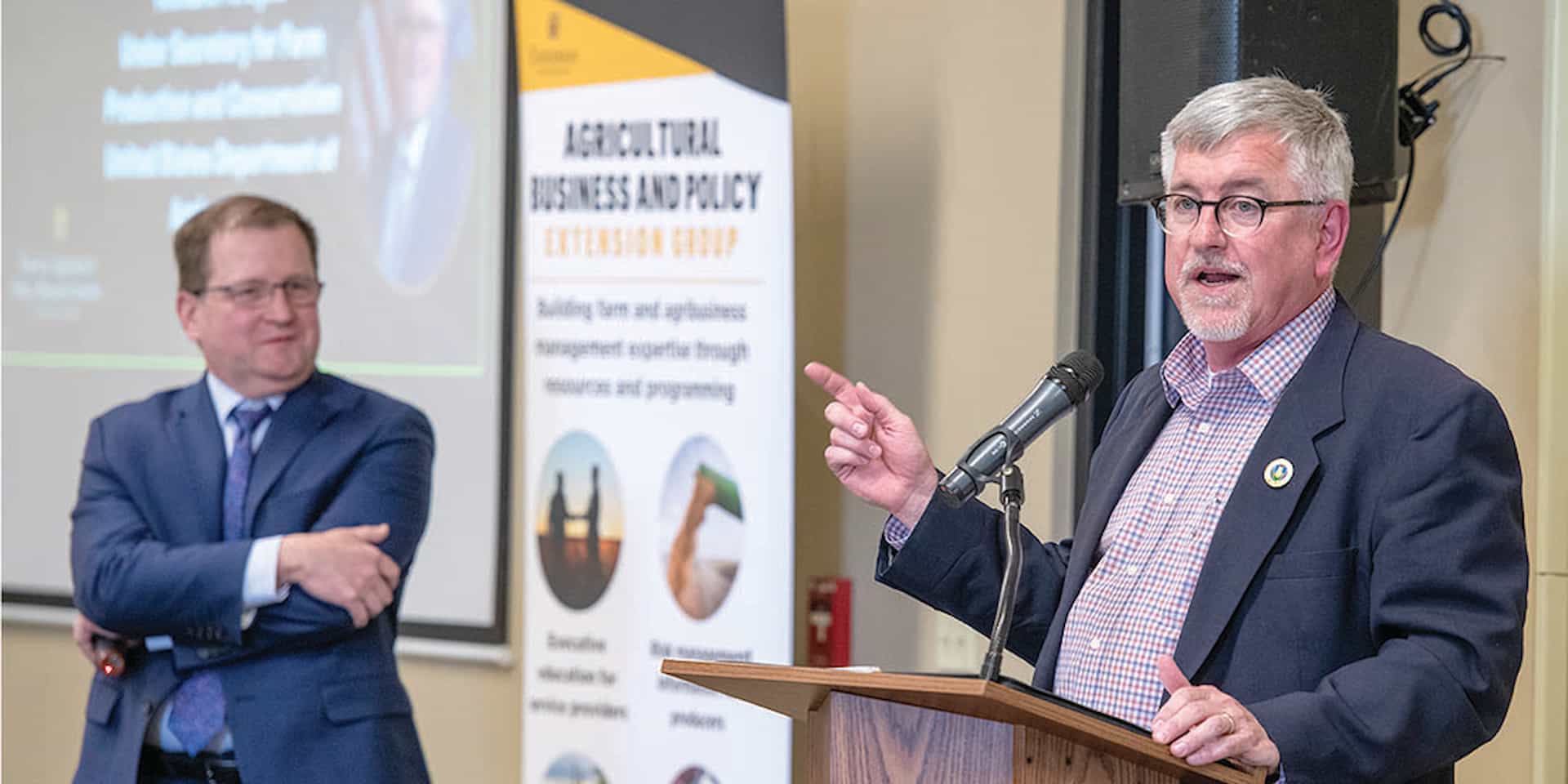
Missouri farmer Richard Fordyce, who was confirmed last fall as USDA undersecretary of farm production and conservation, was also on the agenda to discuss agriculture policies and programs. He emphasized USDA’s new “One Farmer, One File” initiative that will create a single, unified digital record across key agencies, saving time, streamlining services and reducing red tape.
“One Farmer, One File is going to be transformative for the way farmers, lenders and crop insurance agents work with USDA,” Fordyce said. “The days of signing multiple forms for each agency and program are almost over. We’re not there yet, but we’ve got some really good brains working on it. If it were easy, it would have been done a long time ago.”
The conference ended appropriately with a panel of Missouri farmers who shared how they are navigating the uncertainty.
“Years of low financial returns, especially on the crop side, with little to no relief in input costs, have left our producers exhausted in trying to figure out how to yield their way out of this,” said Ben Brown, FAPRI senior research associate who moderated the panel. “Despite the challenges, what I continue to find is that producers have hope and believe in a better day tomorrow.”
Echoing that cautious optimism was Beth Schnitker, a third-generation farmer from Audrain County who runs a cow-calf operation and raises corn, soybeans and wheat with her husband, Herb, and their two daughters.
“As producers, we can gear ourselves up to get through this for one or two years. But the outlook is telling us it could be several more years,” Schnitker said. “That means we have to use some different risk techniques and hone our management skills. As a result, I feel like we’re all going to become better managers, including the next generation who are really going to have to pull themselves up by their own bootstraps.”
FAPRI’s complete 2026 U.S. Agricultural Market Report is available online at fapri.missouri.edu.
Image caption TOP: Panelists discuss animal health threats at the 2026 Womack Outlook Conference hosted by the University of Missouri’s Food and Agricultural Policy Research Institute. From left are Sera Chiuchiarelli, FAPRI; Corinne Bromfield, MU Extension; Elliot Dennis, University of Nebraska; and Jada Thompson, University of Arkansas.
Image caption ABOVE: Richard Fordyce, a Bethany, Mo., farmer, spoke to the FAPRI audience in his new role as USDA undersecretary of farm production and conservation.
***