Out to pasture, into the future
by Emily Kummerfeld
Grazing gives multigenerational dairy a forward-looking path through a changing industry
Almost 70 years ago, Oscar and Thelma Peterson moved with their five children from Iowa to a farm in Grundy County, Mo., near Trenton. Two months later, Brian Peterson was born, becoming the sixth of their seven children. The large family raised several kinds of livestock—including cattle, hogs and sheep—until 1968, when Oscar constructed a Grade-A dairy parlor.
The parlor remains in use today, though much has changed over the years. In 1976, a month before graduating from high school, Brian bought his own herd of 22 dairy cows with help from his dad. Instead of heading to college like his siblings, he wanted to stay and operate the dairy.
 “Teachers said, ‘You don’t study and do well in school. You won’t go anywhere.’ I took that literally,” Brian said with a laugh. His older brother, Gary, also had his own herd, and together the three Petersons milked together.
Later that year, Brian married his high school sweetheart, Barb, who had grown up on a farm only a few miles from the Petersons’ dairy.
“I asked first if she’d milk cows for a living,” Brian said. “Her dad had hogs, and she said, ‘Oh yes, I would.’ So, we’ve been milking for 50 years.”
Soon after, Brian and Gary formed a partnership and bought out their dad’s share of the operation. They milked together as Peterson Brothers Dairy for 15 years until 1993, when Brian and Barb bought Gary’s share. From then on, the couple operated the dairy with their three boys: Opie, Andy and Alex.
Thirty years later, Andy and Alex have pursued different paths off the farm, while their parents continue running the dairy with Opie, his wife, Megan, and their daughter, Jandie, her husband Wayd, and their two children: Borgie, 2, and Lyla, 2 months. Opie and Megan’s son, Cole, is attending the University of Missouri-Columbia, but helps out whenever he can.
As with any workplace, each family member has his or her own job. “We try to stay in our lane,” Brian said.
Barb is in charge of milking the herd’s 150 cows, which in the current eight-stall parlor is not a quick task. “If it was easy, everybody would do it,” she said.
Outside, Brian handles moving the cattle and rotating their pastures, and Opie and Jandie focus on the dry cows, bred heifers, yearlings and baby calves.
“It’s teamwork to get through the morning chores, and we take a break,” Opie explained. “And it’s chores again in the evening. It’s a split shift, basically.”
Working in the evenings isn’t the only difference, he said. “It’s seeing the same people you work with at holidays and weekends and church. So, you’ve got to like them. That helps.”
A change of pace
When Brian operated the dairy with his brother, it was a confinement operation, with the pair growing alfalfa and corn silage to put up in upright silos. “Every day was a busy day,” recalled Brian. “That was almost year-round. There was just always something to do.”
After Brian and Barb struck out on their own, they worked to keep the dairy operating as a confinement system with limited help while their boys were still young. But when one of the Harvestore silos needed repairs, they chose to avoid the costly fix and transition to grazing instead. Making that change, however, proved far from simple.
“The hardest was the cows,” Brian said. “The Holsteins weren’t that great at grazing.”
In addition, to ensure a steady supply of fresh grass, the cows would have to be rotated to different pastures each day, sometimes requiring them to walk a good distance. Some of the previously confined cows were not bred for that task. “They didn’t have the feet and legs for walking,” Brian explained.
As with other aspects of the operation, the Petersons needed to adapt the herd to the new system. Because they raised their own replacement heifers, they introduced new genetics into the herd, starting with crosses to the Montbéliarde breed.
“It’s a French breed that’s higher in components,” said Brian, referring to the amount of fat and protein in their milk. Holsteins may produce a greater volume of milk, but they lack the richness of milk from other dairy breeds.
And that wasn’t the Montbéliardes’ only desirable trait. Originating in a mountainous area, they have a sturdier build that’s better suited for walking and are more efficient grazers.
Building on their success with crossbreeding, the Petersons then incorporated genetics from Swedish reds or Viking reds, a robust Scandinavian breed known for its moderate size, high productivity, ease of grazing and calm demeanor.
The resulting cows are known as a three-way ProCROSS, a dairy professional breeding concept that found crossing Holsteins with Montbéliardes and Swedish reds maximizes heterosis (hybrid vigor) and blends the best traits of each breed.
Today, the herd consists entirely of three-way crosses. To keep that balance in replacement heifers, each cow is bred to the genetics she lacks most, with the goal of improving traits such as moderate stature, good mobility, sound udder attachments and strong feet and legs, according to Brian.
The hybrid herd fits well into the Petersons’ present operations. The dairy has grown over the decades and now occupies about 1,000 acres, divided into rotated pastures, hay pastures and pastures for dry cows and heifers. Brian divides the grazing pastures into 5- to 10-acre paddocks using portable wire fencing. The cows are moved to a new paddock after each milking when the grass is growing, from about April through late fall. In winter, the cows are still put out to pasture but are fed baleage or hay.
It also means the dairy runs at a slower pace. There’s less scooping and shoveling and more rides on the side-by-side vehicle, escorting the cows to their next pasture.
“The culture change was dramatic,” Brian said. “We went from bringing everything to the cows to them doing everything. You’re not raising a plant that you harvest and put up somewhere, then you feed it, and then haul the manure. In a grass base, they’re harvesting; they’re hauling the manure.”
Brian noted that the labor swap benefits both cows and people. “They’re a lot healthier. I think we’re healthier, too,” he said. “The culture among us operators is much more relaxed. It’s more my speed.”
For the cows, he’s seen easier calving, fewer vet calls and less illness. “Now we have no antibiotics on the farm,” Brian said. “When we were confined, we had a list of cattle on penicillin that we were treating for mastitis.”
However, there are some drawbacks. Switching to a grass-based operation results in less control and inevitably some reduction in production. Additionally, the financial aspects are also different.
“It’s lower return, but it’s fairly safe,” Opie said. “We can survive price changes because our costs are so low.”
“And I just love the pace. That’s the reward,” Brian added.
Opie, who graduated from the University of Missouri S&T in Rolla with a degree in mechanical engineering and worked for six years in a manufacturing plant in Trenton before returning to the dairy, said he also appreciates the working environment the grazing dairy provides.
“In the factory, every day is exactly the same, and that got old fast,” he said. “Out here, it’s seasonal. It gets cold in the winter, and it’s hot in the summer, but at least you’re experiencing it all, and I enjoy that. My favorite part of the day is going out to feed these groups of young heifers because it’s just a ride on the four-wheeler in rain or shine. I’ll stand up and take the rain right in the face on those days.”
Growing the grass-fed sector
The Petersons’ youngest son, Alex, returned to the farm for a time after earning a degree in agricultural economics from the University of Missouri-Columbia. Although he had considered a career in politics—even interning for then-senator Roy Blunt—he wanted the chance to work outdoors with his hands and help run the dairy while he was young and able.
Alex’s experiences off the farm, however, would prove invaluable. While working on the dairy, he held leadership roles on several industry boards, including chair of the United Dairy Industry Association and the U.S. Dairy Export Council, among others. For 15 years, he balanced life as a dairyman with traveling the world to advocate for fellow dairy farmers like his own family.
A new chapter began when Alex married his wife, Nida. The couple eventually moved to Nashville, Nida’s hometown, to raise their son, Ellis, 4 months. But moving didn’t put an end to Alex’s commitment to supporting dairy farmers—in fact, it allowed him to expand it. He now serves as the senior director of corporate partnerships and market development at the Dairy Grazing Alliance.
“I feel I can support the dairy industry in important ways from this new perspective beyond the farm gate,” Alex said.
The alliance aims to expand the dairy grazing sector by educating and supplying producers with new technology as well as offering a Department of Labor-approved apprenticeship program. Despite increasing demand, most grass-fed dairy products are still imported from Ireland, New Zealand and Australia.
“There is certainly consumer value for grass-fed products,” Alex said. “And farms like ours produce milk that could have more of its value captured.”
The issue is that while the term “grass-fed” is increasingly seen in grocery stores, there isn’t an official standard defined by a regulatory third party, as there is for the term “organic,” which is certified by the USDA. As a result, consumers may distrust the “grass-fed” label, which reduces the premium they are willing to pay. Together with logistics and infrastructure challenges, U.S. dairy farmers face uncertainty when considering a transition to grass-based systems, Alex said.
“That is exactly what we are trying to shine a light on and help bring together the right players to solve that problem at the Dairy Grazing Alliance,” he said.
His role in the organization is to establish and develop a high-integrity, forage-dominant standard for grass-fed dairy, and the DGA aims to soon introduce a process for producers, processors and brands to obtain that label. If dairies such as the Peterson operation opts to pursue the designation, it could receive higher returns for the way they produce milk.
Grazing ahead
Back on the farm, Opie is also looking forward to expanded market opportunities, including potential ways for grass-based farms to sell directly to consumers. In the meantime, he’s focused on preparing Peterson Dairy for whatever the future holds, from new technologies like heat-detection tags to GPS collars. Most importantly, he plans to upgrade the milking parlor from eight stalls to a double-12 setup, allowing 24 cows to be milked at once.
“Dad and Mom need to retire a little bit, so to make that happen, we’ve got to be big enough to hire some help,” Opie said. The tall Peterson boys have always had to stoop in the current, smaller parlor, and a larger space could comfortably allow two people working at the same time, making it easier to train helpers.
Even with an engineering degree, Opie admits the task is a little daunting, “I’m a little intimidated that granddad built all this 60 years ago,” he said. “It’s going to be a challenge for me to put together something that will last again for a while.”
Like his grandfather and father before him, Opie hopes to build on the foundation they laid, adding another strong layer for the next generation. His daughter, Jandie, plans to continue with the farm and dairy, and she and her husband, Wayd, are building a new home on the property for their growing family. Opie also expects his son, Cole, to stay close by after graduating.
“It’s going to depend on what the kids want,” Opie said, “but I intend to be ready for whatever they say.”
Top Cutline: Brian Peterson of Peterson Dairy near Trenton, Mo., calls to his herd of 150 dairy cows grazing after their morning milking. The dairy operates on a grass-based system from approximately April to late fall, rotating pastures after each milking to give the cows fresh grass.
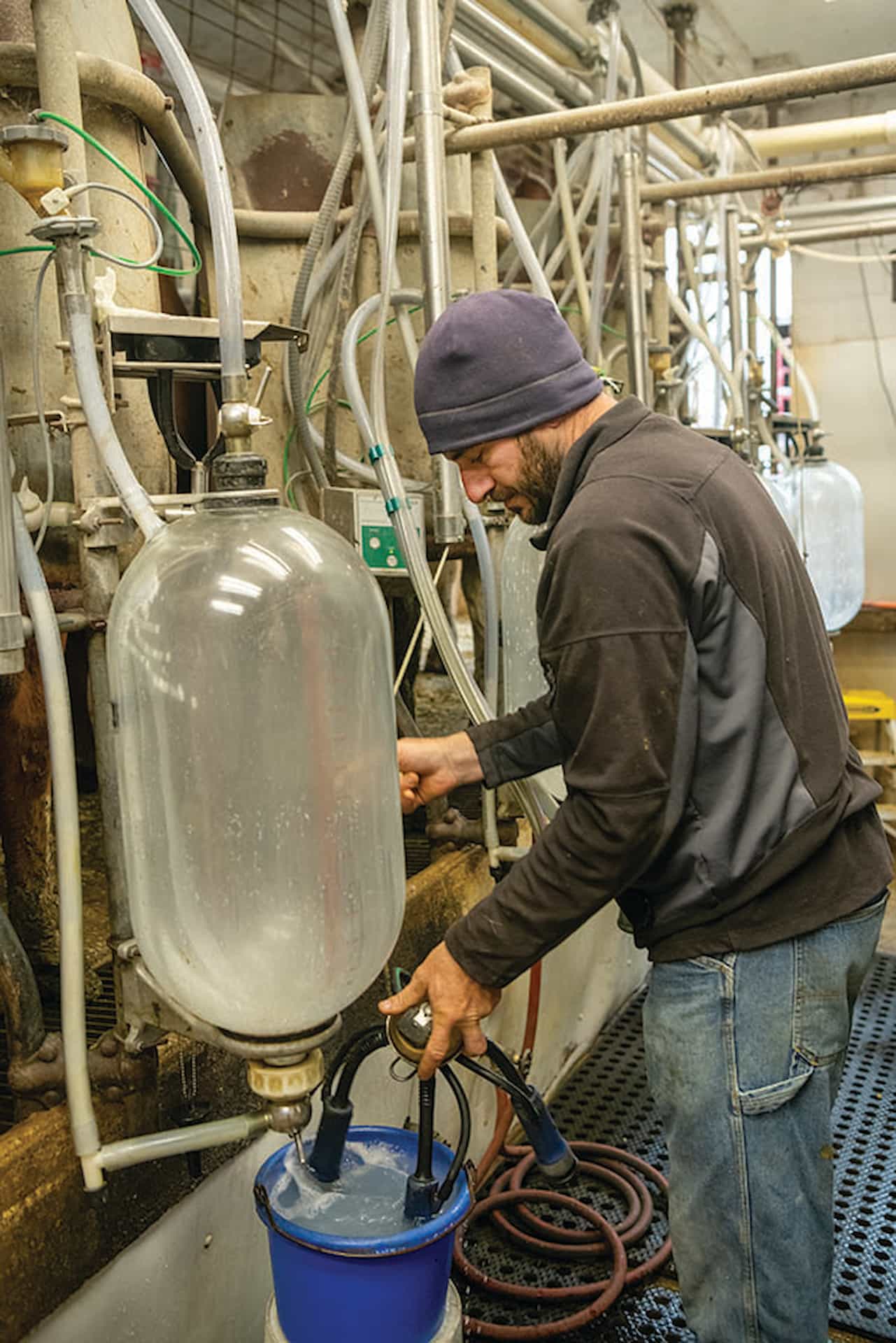
Cutline Above: Opie Peterson helps his mom, Barb, with the morning milking. The third-generation dairy farmer worked as an engineer before returning to help his parents operate the dairy with his brother, Alex.
***
MORE in this June/July Issue.
To view this issue as published via flip book, CLICK HERE: