Agriculture is welcome here
By Allison Jenkins
Ten years into the Agri-Ready County program, more Missouri communities are planning with intention to support farmers and generate long-term growth
When Audrain County became the first in Missouri to earn an Agri-Ready designation in 2016, it was stepping into relatively uncharted territory. Agriculture had long anchored the county’s economy, but formally committing to ag‑friendly planning and policy marked a new, intentional approach to growth.
Steve Hobbs, who served as presiding commissioner at the time, said the decision grew out of a clear-eyed look at what sustained the county—especially during economic downturns.
“Agriculture had always been there, steady and strong, driving the economy,” Hobbs said. “As ethanol and biodiesel came online, we became known as the Biofuel Capital of Missouri. What we realized was that even when the broader economy struggled, agriculture kept things going. So, we made a very intentional decision to promote what we already had and look for businesses that fit into value‑added agriculture.”
That mindset aligned closely with the Agri-Ready County initiative, which is managed by Missouri Farmers Care (MFC), a coalition of more than 40 leading agricultural groups, including MFA. The voluntary program was designed to help counties examine how planning, zoning and infrastructure decisions could either support—or unintentionally hinder—agricultural growth.
“The goal was for Missouri agriculture groups, farmers and their collective voices to do a better job in collaborating with and supporting leaders at the local level,” said Ashley McCarty, MFC’s executive director. “We wanted to effectively be engaged in conversations about opportunities around growth and regulatory decisions that county leadership was making. And 10 years later, I would say that vision has played out.”
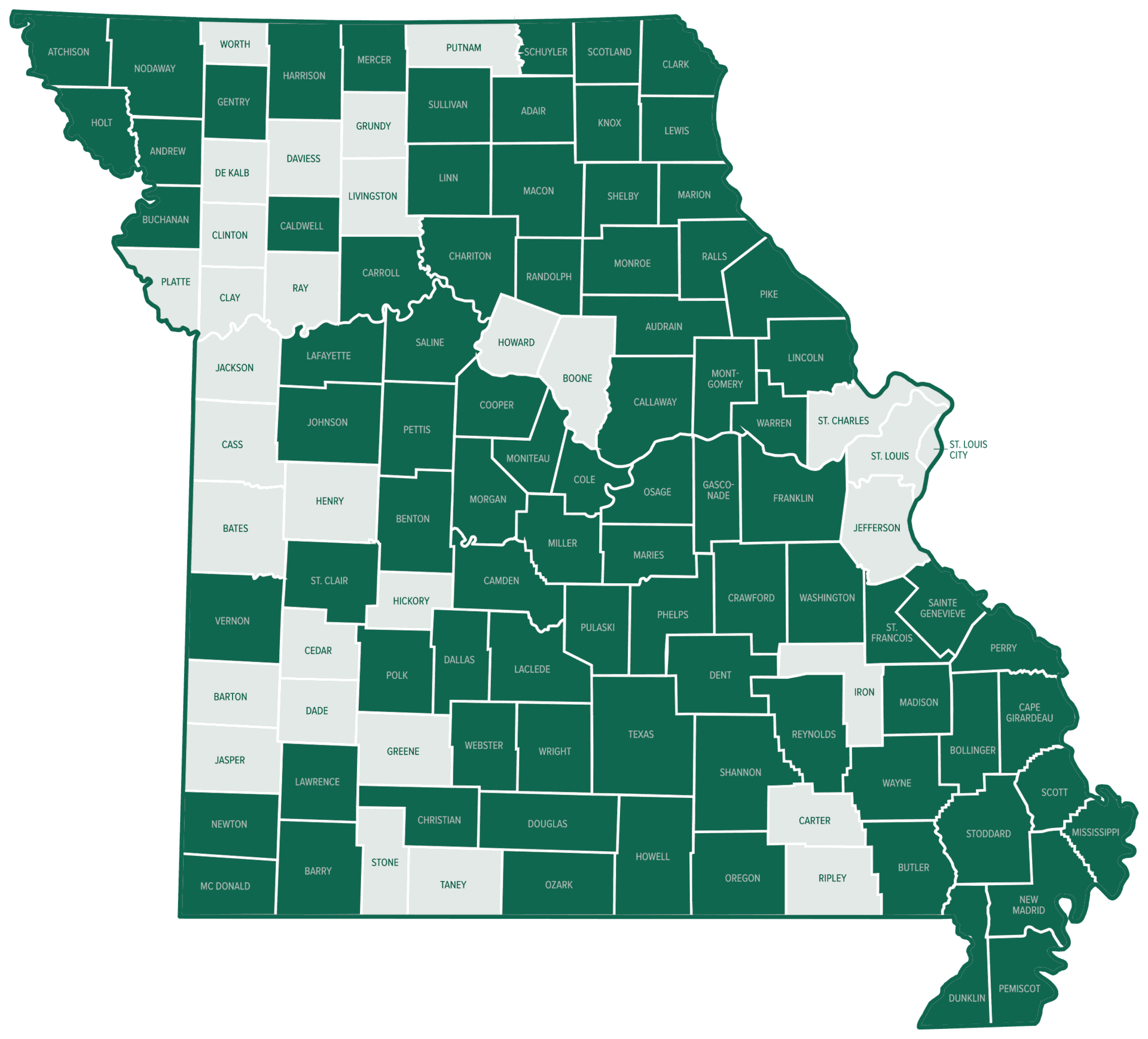
The Agri-Ready designation has now been granted to 82 Missouri counties, including Linn County, which officially joined the list in early February 2026.
“It’s very much a relationship program,” McCarty said. “We’ve been in conversations with probably 100 of the 114 counties. And it’s not just ag groups in the room—it’s local leaders, business owners, processors, lenders and educators, all coming together to talk with county commissions about the value of agriculture. That collaboration is the magic.”
At its core, Agri-Ready isn’t about recruiting a specific project or promising immediate development. Instead, it’s about ensuring county leaders understand agriculture’s role in their local economy and are prepared when opportunities arise. Plus, it underscores a commitment to the agricultural industry and the farmers who are the backbone of Missouri.
“I’ve seen impact at two levels,” McCarty said. “Locally, agriculture feels seen, heard, appreciated and supported. That, in turn, gives entrepreneurs and businesses room to take some risks and say, ‘This is a great place to grow.’”
The Agri-Ready framework guides county leaders through a detailed evaluation of policies related to zoning, land use, infrastructure and community awareness. Education is a major component, helping elected officials and residents better understand modern agriculture and today’s agribusiness needs.
 It is not a rubber-stamp process. To earn Agri-Ready status, counties cannot have any regulations impacting agriculture that are more restrictive than state law, and they must meet all other program requirements. After the application is received from the county commission, MFC affirms compliance before awarding and announcing the designation.
“Agriculture knew early on that a patchwork of regulations across the state would be a barrier to business,” McCarty said. “If rules change every time you cross a county line, that’s hard in the fast-paced environment of ag production and processing. Missouri isn’t the Wild West. There is a robust, science-based set of regulations to ensure agriculture can thrive in an environmentally sound way. What Agri-Ready does is provide solid footing so businesses know they won’t face additional roadblocks at the local level.”
In some cases, counties pursuing the designation have had to rescind contradictory ordinances and overly burdensome regulations to align with that goal.
“Regulatory certainty is exceptionally important,” McCarty said. “As capital investments grow, knowing there’s stability ahead—for farmers, businesses and their lenders—is transformational. It removes one of the many unknowns agriculture already faces.”
That emphasis on certainty has helped the program resonate with counties across the state, from deeply rural areas to those experiencing rapid population growth and development pressure. A prime example is Christian County, one of the latest to earn Agri-Ready status. Bordered by the bustling areas of Springfield and Branson, it is one of Missouri’s fastest-growing counties, and Presiding Commissioner Lynn Morris said he believes the Agri-Ready program will help ensure agriculture remains part of the conversation.
“We’re losing farmland, but what we have is extremely important,” Morris said. “We produce beef, pork, poultry and all kinds of crops here. It’s a major part of our economy and a food source far beyond Missouri.”
For the commission, Morris said the decision to join the roster of Agri-Ready counties was straightforward.
“It was kind of a no-brainer,” he said. “We decided that this would supplement everything else that we do in Christian County. We’re just getting started, but I’m anxious to see what 2026 will bring.”
Likewise, in Audrain County, Hobbs said the designation helped ensure agriculture had a consistent seat at the table as leaders discussed growth, infrastructure and long-term planning.
“We’ve used Agri-Ready to try to attract dairies and other value-added businesses that work with agriculture,” said Hobbs, who served on the county commission from 2011 to 2021, when he became executive director of the Missouri Association of Counties. “We have the Missouri Plant Science Center here now, ancillary businesses tied to biofuels, and continued growth that supports the economic base we have with agriculture. Commissions after I left have continued to lean into that.”
As Agri-Ready expanded, Missouri Farmers Care learned that flexibility mattered. No two counties look the same, and the program was never intended to be one-size-fits-all.
“Our Agri-Ready counties are as diverse as our state,” McCarty said. “The vision of growth looks different everywhere.”
One of the clearest examples of Agri-Ready principles at work is in Warren County, where America’s Heartland Packing opened a large-scale beef processing facility last year. Located just off I-70 on the urban fringe of St. Louis, the 800,000-square-foot complex brought jobs, investment and expanded markets for livestock producers—outcomes that McCarty said don’t happen by accident.
“We were there from the beginning, and Agri-Ready helped to show just how supportive and welcoming the local leaders would be,” she said. “That message was heard loud and clear.”
The facility draws cattle from a wide radius, strengthening markets for producers across Missouri.
“They’re buying fed cattle, and they’re buying cows,” McCarty said. “That’s huge for a cow-calf state like Missouri.”
While Agri-Ready is no guarantee of development, it positions counties to respond when opportunity knocks. Participation also creates a network of counties learning from one another, sharing experiences and refining best practices as agriculture and rural communities evolve.
“We’ve had counties take a wait-and-see approach,” McCarty said. “Now, years later, they’re calling us back to revisit Agri-Ready. That’s exciting.”
As Agri-Ready enters its second decade, McCarty said she sees continued opportunity—both to add new counties and to deepen engagement in those already designated.
“We’re really encouraged by the continued growth of the Agri-Ready program,” McCarty said. “Will we see all 114 counties join? That’s hard to say. As you get into a more urbanized area, there are a lot more rules and regulations. That doesn’t mean we won’t work with them, but that relationship may look different. We will continue to join the conversations where growth is happening and support the counties that have hung up the sign showing they are Agri-Ready—open for the business of agriculture.”
For more information on the Agri-Ready County designation, visit MoFarmersCare.com/agri-ready or contact Ashley McCarty at ashley@mofarmerscare.com.
Top Image caption - Audrain County, which was the first to be designated as Agri-Ready by Missouri Farmers Care in 2016, recently hosted a tour for the National Association of Counties’ Rural Leaders for Economic Mobility program. This initiative brings together leaders to explore and implement strategies that drive rural prosperity. Here, the group visits the POET ethanol plant in Laddonia. Such events are a regular occurrence for Audrain County, which has fully embraced the Agri-Ready motto of “open for business.”
Map above - With the addition of Linn County in early February, 82 of Missouri’s 114 counties are now designated as Agri-Ready and eligible to display the sign, pictured at right, that declares they are “open for business” in agriculture.
***
CLICK HERE to read more from the February/March Today's Farmer magazine.
To read past issues of Today's Farmer, CLICK HERE.