Building a resilient residual herbicide program
by Doug Spaunhorst, Director of Agronomy
We aim for residual herbicides that both “activate” effectively and maintain “persistence,” yet it’s uncommon to find products that achieve quick activation while enduring adverse conditions.
What is a resilient residual herbicide program? To me, it means starting with a foundation of a residual herbicide that not only covers the spectrum of weeds you need to control in your field but also when you need them controlled. We aim for residual herbicides that both “activate” effectively and maintain “persistence,” yet it’s uncommon to find products that achieve quick activation while enduring adverse conditions.
 Residual herbicides differ in activation requirements—the amount of rainfall or irrigation needed to get the product in soil solution and into the germination zone for root and shoot uptake. Some are very water soluble, needing only light rainfall or irrigation (0.25 inch) to activate. Greater rainfall or irrigation amounts (0.5-0.75 inch) may be necessary to activate less-soluble products. The chemistry dictates solubility and how much moisture is needed for activation.
Other conditions, such as soil moisture at the time of application and soil texture, can further impact activation requirements. Ground worked to a powder and then sprayed likely won’t have enough subsoil moisture to facilitate herbicide activation. Heavy rainfall following that scenario will likely not evenly distribute the residual herbicide and carry both soil and chemistry downfield. Conversely, a field that has some level of soil moisture ahead of spraying may provide more desirable weed control results.
In cases where there was no issue with activation, but weed control was poor, what does the ground look like? Seedbed preparation is critical for seed establishment and residual herbicide activity, too. Does your herbicide first address the weed issue, and then is it likely to activate based on typical weather patterns and soil conditions when you spray?
Persistence is the second part of the equation. How strongly does your herbicide bind to soil or organic matter? Is the dose enough to control late-emerging weeds, or am I applying the minimum use rate to shave cost? From my experience, using the minimum use rates results in two or three outcomes. First, I will be respraying when I should be doing something else. Second, I will spend more money to control emerged weeds while hurting yield. Third, all too often I’ll be fighting the same weed issues I had in previous seasons.
 We often focus on soil pH in terms of nutrient availability. Soil pH below 5 and above 7 may cause nutrient deficiency or toxicity. But did you know that soil pH impacts herbicide persistence, too? In less-than-ideal ranges, the herbicide charge can change, impacting its natural breakdown. And high soil pH doesn’t always mean more persistence. Sometimes, herbicides can persist longer at a low soil pH. Getting your soil pH in the correct range is good for both nutrient availability and persistence.
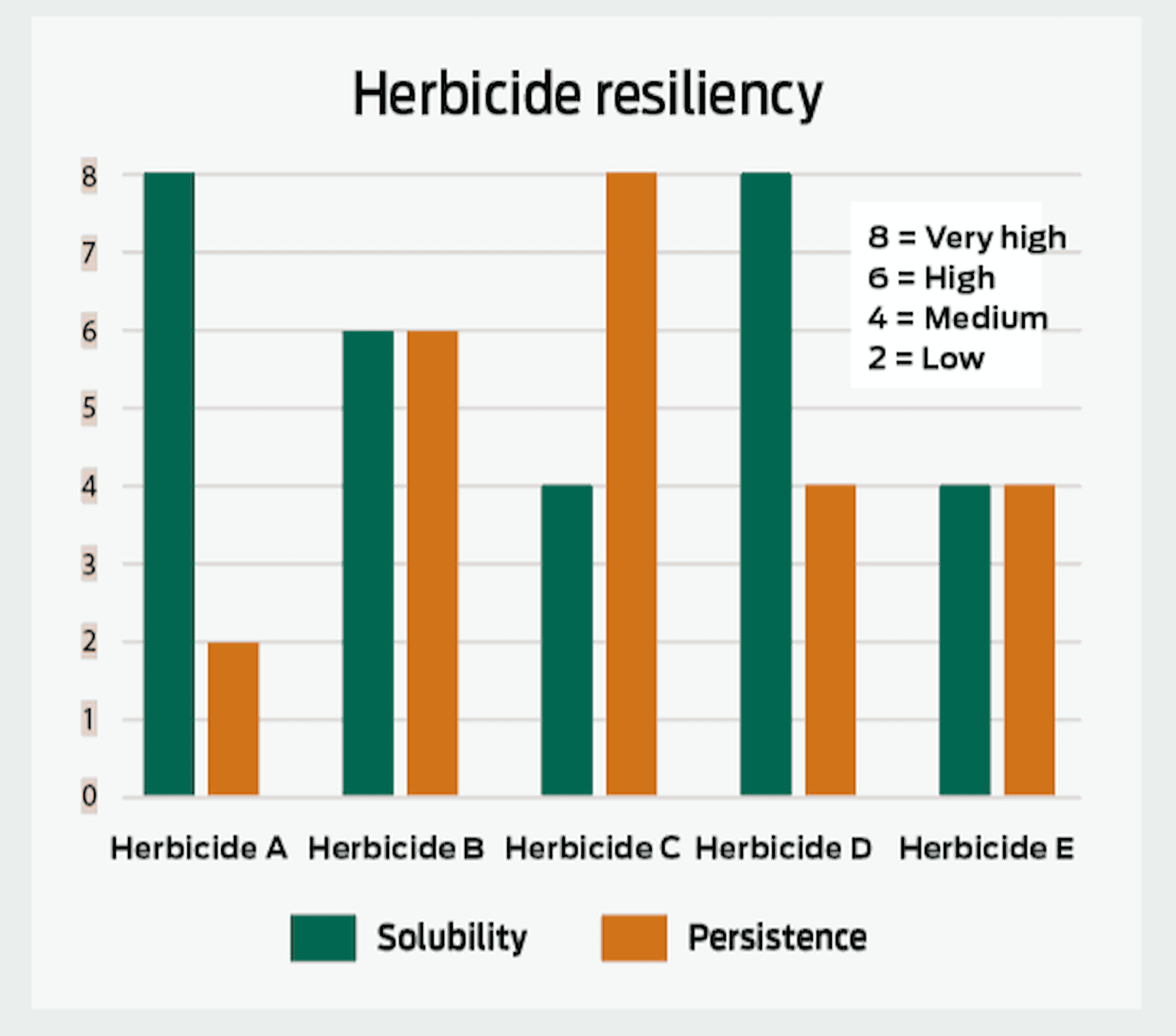
Using multiple herbicide sites of action is not only advisable for resistance management but also activation and persistence attributes. This helps build a program that is more resilient. The chart outlines solubility and persistence attributes of five common corn and soybean residual herbicides. Products A and D have high solubility and require 0.25 inch of rainfall or irrigation for activation, while herbicides C and E have low solubility and require 0.75 inch of rainfall to activate. Herbicides B and C are persistent and not easily moved out of the soil profile. Herbicide A is not very persistent and readily moves out of the soil profile after repeated rainfall or irrigation.
Herbicides that contain multiple active ingredients or a tank mix not only add to the spectrum of weeds controlled but, when paired properly, can also be easily activated early and persist late. For example, mixing herbicides A and C provides more resiliency when rainfall is unpredictable. Herbicide A provides weed control when rainfall is light, and herbicide C persists further into the growing season.
Though no program is perfect, resiliency gives you a better chance of having a clean field until a planned second pass or canopy closure. Reach out to your MFA trusted advisor for assistance in evaluating your 2026 crop protection plan for resiliency.
***
CLICK HERE to read more from the February/March Today's Farmer magazine.
To read past issues of Today's Farmer, CLICK HERE.