Decades of data and decisions
By Allison Jenkins
For more than 30 years, MFA’s precision program has focused on smarter farming
Long before Mark Siebert began using precision agriculture on his row-crop operation in Scott County, Mo., he was already farming by its principles. He knew which parts of his fields consistently yielded the best, which spots struggled every year and which areas always seemed to create problems.
What he didn’t have was a way to capture that knowledge—acre by acre—in a form that could reliably guide management decisions. So, when MFA Agri Services in Chaffee became one of the first retailers to offer grid soil sampling and variable-rate fertilizer applications in the mid-1990s, Siebert didn’t hesitate to try it.
At the time, quoted in the June/July 1996 issue of Today’s Farmer, he said the reason was simple: “This way, we can spend our money where it does the most good.”
Over the next 30 years, that same idea not only guided Siebert’s farm management philosophy but also the evolution of MFA’s precision agronomy services. While the technology has changed tremendously, the purpose has not. From its very beginnings, precision offerings at MFA have been about gathering and applying data in ways that help farmers explain field-level variability, increase efficiencies and maximize both input investments and yield potential.
“The thing that really drew me to precision—and still does today—is that every field has a story to tell,” said Thad Becker, who spent more than 20 years working in precision agronomy for MFA before leaving to farm full time in 2022. “We all knew the variations. Before soil maps and yield monitors, we saw the difference in the field and heard the difference rumbling through the combine. Precision just gave us the ability to pinpoint and manage those differences in an efficient way.”
Prior to the official launch of MFA’s Precision Advantage program in 1996, a handful of MFA employees and locations across the system were already exploring emerging tools to help growers farm smarter. This work was happening largely without the benefit of today’s digital infrastructure, requiring patience, persistence and more than a little faith in what the technology might someday become.
There was no internet connectivity in the field, no cloud-
based platforms and no tablets or smartphones to instantly process or share information. GPS was still mostly military-
based technology, Microsoft Windows 3.0 had just been released, and yield data was collected by analog monitors, stored on disks and physically moved from cab to computer.
One of the early believers in the promise of precision, 45-year MFA employee Ken Harvey began working with farmers in the early 1990s to install some of the first yield monitors in the region and experiment with precision soil sampling. At the time, the tools were crude by today’s standards, but Harvey said the potential was obvious.
“There was a huge learning curve,” said Harvey, a precision agronomy specialist based in Kahoka, who serves MFA’s District 3 in Northeast Missouri. “We were trying to master soil data points. We had to find labs that could work with us, and we had to invest in beta versions of software. It wasn’t easy, but the idea of being able to go back to the same spot, year after year, and compare soil samples to yield data was exciting.”
MFA was, indeed, a pioneer in the technology, pushing for its adoption and testing its potential ahead of most other agribusinesses in Missouri or even the nation, Becker said.
“When it comes to precision agriculture, nobody comes close to what MFA can do for customers in our trade territory,” he said. “A lot of people shared that vision and saw the value for our producers. And a lot of people struggled and beat their heads against the wall for years to refine the program and build a system that works and continues to get better.”
Leading-edge learning
At MFA Agri Services in Chaffee, precision moved quickly from experimentation to implementation. Not long after the facility was completed in 1994, Chaffee began offering site-specific liquid fertilizer application, using Terra-Gator Soilection spreaders—some of the first commercially available variable-rate application equipment.
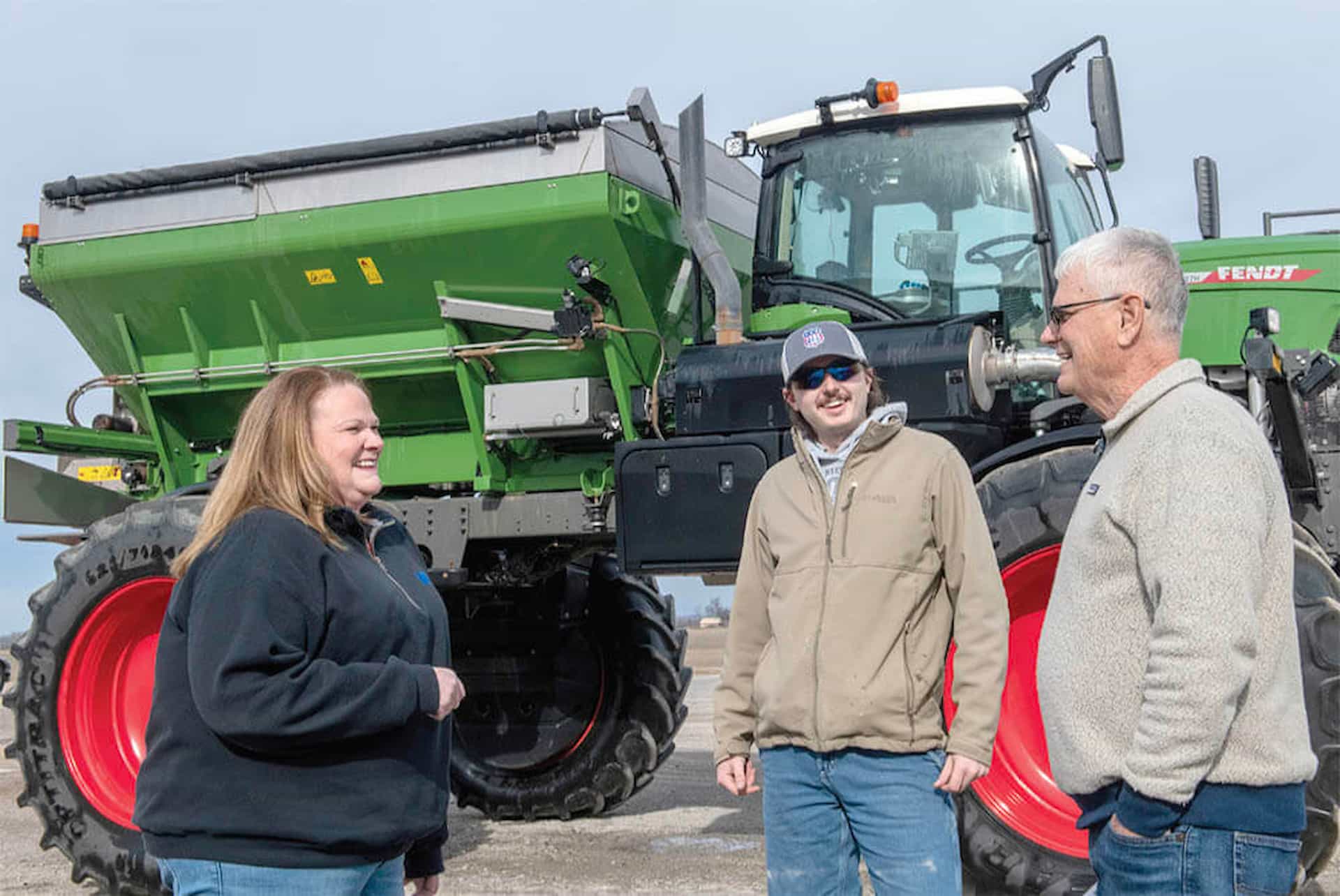 In 1997, Cassy Landewee joined the Chaffee team and was soon tasked with managing precision agronomy services for customers like Mark Siebert. By then, interest in grid sampling and variable-rate application was growing, even as the technology continued to transform.
“Back then, this wasn’t something you learned in college. It was hands-on, learning from experience,” Landewee said. “The intent was to take the yield data that our growers were obtaining and put that together with our recommendations. Software was limiting then, and the technology of yield monitors was not quite there, but we knew there was value. We kept seeing the technology advance, and today, I really don’t know any farmers around here who haven’t jumped into precision in some form or fashion to make their lives easier.”
For Siebert, the value proposition never changed, even as the tools did.
“Before precision, we were just giving it our best educated guess,” he said. “Now, we’re putting our fertilizer, seed and chemicals where they’re going be most effective—more bang for your buck, I guess you’d say.”
The early years of precision were marked by trial and error. Yield maps were imperfect, equipment was temperamental and translating raw data into solid recommendations was often more art than science. Still, those early adopters who stuck with it now have decades of data and experience that not only benefit their current operation but also future generations.
“When Ken (Harvey) approached us with the idea of precision, it was new and exciting, something you could see instantly as you’re going through the field,” said Mark Plenge, who farms with his father, Ralph, and son, Blake, in Kahoka. “Here in Northeast Missouri, we have a lot of clay-based soils, and I was interested in a better way to manage the variances out there. It seemed to evolve pretty quick after we got started, and there have been a lot of advantages over the years.”
Transformational tools
Like many of his neighboring farmers who work with Harvey, Plenge’s first plunge into precision was a yield monitor in the late 1990s followed by grid soil sampling and then variable-rate planting and fertilizing. Along the way, automation began to deliver some of the most tangible benefits. Growers point to technologies such as autosteer, automatic sprayer boom shutoffs and planter clutch systems as game changers—tools that reduce overlap, save inputs and make long days in the field more efficient.
“Planter clutches were a big turning point, and the seed savings were significant,” said Kahoka producer Jay Cameron. “I remember Ken telling me that when I went to the clutches, I’d find out I wasn’t farming as much as I thought I was. And sure enough, next thing you know, a 68-acre field became 63 acres once you accounted for all the waterways and point rows.”
As part of its precision services, MFA collaborated with technology developers such as Ag Leader, Trimble, Precision Planting and John Deere to sell, install and help farmers learn to use the rapidly evolving equipment offerings. But technology alone wasn’t enough. The real challenge was turning mountains of information into reliable, useful recommendations. To that end, MFA created a team of precision agronomists to work with farmers in making data-driven decisions.
“Those precision specialists were key to figuring out what worked and paving the way—and they still are,” Becker said. “They’re the ones who understand what the data has the capability of doing and how to help growers see the value of it to their fertilizer recommendations, to their seed program and to their overall operation.”
Along the way, MFA invested heavily in building systems, procedures and training that ensured precision agronomy services were delivered consistently across the organization. The Nutri-Track precision nutrition management program was launched in 2007, and participants today continue to benefit from services that include 2.5-acre grid soil sampling, yield monitor data analysis and prescription fertility recommendations.
“When I came on board, we were in the early days of standardization, and that’s something that needed to happen,” Becker said. “Once we got to where things were more cross-compatible, we were able to scale up our program and create a system that would work across MFA’s trade territory and gain the trust of the producer.”
Beyond efficiency and economics, the technology has also reshaped how farmers and MFA approach stewardship. By applying fertilizer and crop protection products only where they are needed—and at the right rates—precision practices help protect natural resources while maximizing return on investment.
“For people who think farmers are polluting everything, precision ag can prove to them that we’re not overapplying,” said David McCutchan, an early adopter who began with yield monitoring, grid sampling and variable-rate anhydrous ammonia in the late 1990s on his farm in Monticello, Mo. “We’re pinpointing our fertilizer, building up in areas that need it, and backing off on those areas that don’t. We don’t want extra fertilizer laying around in places where you can’t grow a crop.”
Future built on the past
Today, MFA’s precision agronomy program continues its proven practices and services while evaluating emerging technologies with the same disciplined approach that has defined the program for more than three decades. Blake Peterson, MFA precision agronomy and retail fleet data manager, listed a few of what he sees as high-potential current and coming advancements:
· John Deere’s See & Spray Ultimate precision applicators. MFA was one of the first retailers in Missouri to use the technology, which uses advanced cameras and machine learning to detect weeds in real time and applies herbicide only where it’s needed.
· MFA’s use of the FieldAlytics digital platform, which is now managing everything from grower data to application dispatching across one, integrated system. Peterson said FieldAlytics enhances store and group efficiencies and empowers employees at all levels with the information they need at their fingertips.
· Real-time kinematic (RTK) field boundaries, which represent data down to the inch, compared to 2 to 4 meters with standard GPS. More than 100,000 acres of RTK boundaries are now logged in FieldAlytics after only a year of mapping, Peterson pointed out.
· State-of-the-art New Leader NL7 beds that offer high-precision applications in a 120-foot pattern. Peterson said the agronomy hubs now using this spreading technology are leading the way in productivity across the MFA system.
· Genetic testing of soil samples that could help predict disease potential in the field before a crop is even planted.
As for the future, Peterson said MFA is also positioning itself to be ready when automated equipment becomes feasible and investigating the use of advanced imagery to refine management zones.
“MFA is on the leading-to-bleeding edge of precision technology,” he said. “We have strong roots with our Nutri-Track program, but we’re also looking toward the future every day and trying to figure out how we can improve not only a customer’s operation but also our organization. We try different things. Some of them fail; some of them work. We’re not afraid of trying something new.”
From floppy disks and analog data to cloud-based platforms and real-time decision tools, precision agronomy at MFA has advanced by leaps and bounds since its earliest days. Yet at its core, the mission remains unchanged: to help farmers understand their fields better and spend their dollars where they deliver the greatest return.
“MFA has invested a lot of time and money in our precision program, and it’s always been about what’s best for the producers,” Harvey said. “I can’t think of any bigger impact that MFA could have had on agriculture.”
For more information on MFA’s precision services, visit online at mfa-inc.com/services/precision-agronomy or visit with your local MFA solutions provider.
Photo up top: These Northeast Missouri farmers are among the many who have worked with MFA Precision Agronomy Specialist Ken Harvey, standing, throughout his 45-year MFA career. All of these growers were among the early adopters of precision technology, encouraged and supported by Harvey and other MFA team members in the region. From left are Cole and David McCutchan, Harvey, Jay Cameron, and Ralph and Mark Plenge.
Photo above: Mark Siebert, right, a longtime member of MFA Agri Services in Chaffee, was one of the first to try precision sampling and fertilizing when the location began offering the services in the mid 1990s. Assistant Manager Cassy Landewee, left, has worked with Siebert through most of those years, and more recently, so has custom applicator Damon Stearns, center.
***
Check out the story as printed via flipbook CLICK HERE.
CLICK HERE to read more from the February/March Today's Farmer magazine.
To read past issues of Today's Farmer, CLICK HERE.