Purpose in the pain
By Allison Jenkins
Missouri farm family turns personal tragedy into hope, breaking stigma around rural mental health and suicide prevention
Talking about suicide is never easy. It’s hard to say. Even harder to accept. But the Foreman family of Shelby County, Mo., has found the courage to tackle this tough topic publicly, because they know firsthand the devastating effects of losing someone to the unspeakable.
“It’s about figuring out purpose in the pain,” said Jolie Foreman, farm wife, mother and executive director of the nonprofit Shelby County Cares. “We’ve gone through a lot. But the biggest miracles come out of the messiest situations.”
That willingness to break the silence and stigma surrounding mental health is at the heart of Shelby County Cares (SCC). Established in 2023 with a Missouri Foundation for Health grant focused on firearm suicide prevention, SCC brings mental health education, awareness and support services to agricultural and rural communities. Jolie became SCC’s full-time executive director in November 2024 to lead the organization’s mission.
The need is urgent, and the statistics are startling. The overall suicide rate in Missouri has increased nearly 60% over the past two decades, and Shelby County was ranked No. 1 in firearm suicides in the state when Jolie helped write the SCC grant proposal.
“Now we’re 24th,” Jolie said. “I’d love to think we’ve helped turn that tide, but unfortunately, in this work, it’s easier to count the lives we’ve lost than the ones we’ve helped save.”
However, progress in one county doesn’t tell the full story. The crisis extends across northeast Missouri, where seven counties are in the top 30 for firearm suicide statewide, and 12 fall within the top 50. Shelby County’s neighbor, Macon County, now ranks second and Montgomery County fourth.
The agricultural community is particularly at risk. Nationally, studies show farmers are two to three-and-a-half times more likely to die by suicide than the general population. Long hours, financial stress, unpredictable weather and isolation all take a toll, compounded by limited or nonexistent access to mental health services in rural areas.
“We knew that the rates were high, but when we started looking at the names of those who had died by suicide, we could tell that predominantly, like 85% of them, were farmers or had direct ties to agriculture,” Jolie said. “Farmers face stress that often goes unaddressed throughout their lives. Combine that with the prevalence of firearms in farming families, and it can be deadly.”
Personal loss, public mission
Shelby County Cares is working to reverse that terrible trend through outreach, training, therapy services and suicide prevention efforts. It’s a powerful purpose that hits home for Jolie, whose husband, Jarrell, and his father, Brent, farm together and deal daily with the challenges of growing row crops and running a commercial red Angus herd.
 They’ve also been affected by suicide—not once but three times in recent memory.
“The need was there, but it is also personal for me,” Jolie said. “My husband’s family has been impacted really hard by suicide. That was the nudging in my heart that I needed to do more, give back and to hopefully come up with a way that our family and others don’t have to continue living with this struggle.”
Brent was 12 years old when his grandfather, J.D. Copenhaver, died by suicide in 1971. A livestock and grain farmer, J.D. was well respected throughout the community, his grandson recalled.
“He was probably the most important figure in my life, so it’s hurtful,” he said. “He’s been gone 54 years, but that hurt never goes away.”
In 1988, the unfathomable happened again. Brent’s younger brother, Craig, took his life with a firearm at age 26.
“It was tough, and I really feel for my mother,” Brent said. “She lost her father, who she was very close to, and then her youngest child to suicide.”
And then Memorial Day weekend in 2023, just as Shelby County Cares was getting started, Brent’s brother-in-law, Nolan Gibson of Lewistown, Mo., died by suicide as well. He was 67, a part-time cattle farmer who had just retired from his utility company job.
“He was a guy who was full of life and fun to be around, and we’ll never know the answers,” Brent said. “He was the brother of my wife, Raena, and I just see the pain in her eyes daily.”
“Everybody loved him,” Jarrell added. “Just the last person in the world you’d ever think would consider something like that.”
Those troublesome unknowns are exactly why more awareness and resources need to be made available, Jolie said.
“Suicide is a permanent solution to a temporary problem,” she said. “People may believe that the world could be better if they were not in it for whatever reason, but they don’t understand that is not true.”
This sobering reality emphasizes why conversations and connections matter just as much as professional resources. If someone is struggling, Jarrell said the first step doesn’t have to be complicated.
“Talk to somebody. Heck, anybody. It doesn’t have to be a therapist,” he said. “I know it’s tough for people in my shoes. I have buddies who are struggling, and I’ll call just to check on them. Sometimes they just need to get stuff off their mind and talk.”
Brent echoed that mindset. “I don’t care who you are, you’ve got to have a good circle of friends,” he said. “And you’ve got to lean on them if you need to, and vice versa. Don’t be afraid to seek out those people.”
Hope in action
Over the past year, Shelby County Cares has hosted an awareness walk and youth gatherings, recruited teen advocates for peer-to-peer outreach, promoted safe firearm storage, organized meal-prep events for farm wives, trained volunteers to recognize warning signs of suicide and offered resources for families dealing with loss or mental health challenges.
These activities are simple by design: a free meal, a friendly face, a safe place to talk. Those gestures matter in the male-dominated agricultural industry, where the independent nature of farmers and philosophy of “pulling yourself up by your bootstraps” can make it difficult for people to admit they’re struggling.
“Farmers are used to fixing things on their own,” Jolie said. “They take care of the land, the animals, their families—but they don’t always take care of themselves. We’re trying to change that, little by little. But plugging into men is not easy. We had to get creative.”
Jarrell understands the hesitation many farmers feel when reaching out for help, especially in a small, tight-knit community.
“Calling another farmer can be tough, especially if you’re farming in the same neighborhood. We all understand how that could work,” he said. “But there are people out there who would bend over backward to help you out. That’s something really good about this industry. Down here in the grassroots part of it, we still take care of one another.”
A perfect example is SCC’s “Feed the Farmer” event, held on a Saturday during the hectic harvest season, a particularly stressful time for farmers. On Oct. 18, volunteers from local businesses, churches, FFA, 4-H and the community prepared 261 barbecue meals, packed goodie bags and distributed them to farm families across Shelby and Macon counties. Next year, Jolie said she hopes to expand the program to reach families throughout Missouri.
“We developed Feed the Farmer as a way to not only give back to the agricultural community but also connect with farmers and share hope,” Jolie said. “There are people out there who may not hear, ‘You can keep going’ or ‘You matter.’ They’re not going to come into our office for therapy. So, we have to go out to them, to let them know we care.”
That message came through loud and clear to the farmers and family members who eagerly expressed their gratitude as they picked up their meals. “I heard from several folks who said they were glad they didn’t have to eat another bologna sandwich!” Jarrell said.
Brad Wilt, who farms just outside Shelbyville, shared a similar sentiment as he finished his meal before tackling repairs on his broken-down combine.
“It’s a better lunch than I usually get on the run at Casey’s,” he said. “A lot of people don’t realize just how much goes into farming, especially when we’re out here harvesting, so it’s nice to be recognized.”
The meals also lightened the load for the farm wives who are normally responsible for feeding the harvest crews.
“This keeps me from having to fix lunch for everyone today!” exclaimed Linda Echternacht of Leonard as she picked up meals for seven farming family members. “This is really appreciated.”
A critical component of this effort were the gift bags, which were packed full of useful supplies for farmers along with snacks and thank you notes from 4-H and FFA members.
“Those cards were amazing. They gave me goosebumps,” Jolie said. “And I heard from so many farmers that they just loved them. The kids really put a lot of heart in their messages. It was such a neat way to remind the youth to thank our farmers.”
Mental health resources were also subtle but significant inclusions. Among the items were koozies and a vehicle decal imprinted with the 988 suicide prevention and crisis lifeline number along with materials about other farm-specific programs.
An accompanying flyer, listing the numerous community sponsors who contributed to the gifts, opened with the message, “You are seen. You are valued. You are not alone.”
“Each item in the bag was chosen purposefully to be something the farmers could use, especially when times get really busy and stressful,” Jolie said. “And then I got to sprinkle it with 988 and AgriStress helplines and the Extension programs for mental health. I hope they never have to use those resources, but we wanted to make them available.”
From Shelby County to the spotlight
The impactful work of Shelby County Cares and the Foreman family’s willingness to talk about a tough subject have gained national attention in recent months. They were featured in a Farm Journal piece coinciding with Suicide Prevention Month in September and in a story that aired in early November on the long-running CBS news show “60 Minutes.”
Being under such public scrutiny has been difficult, the Foremans admitted, but the potential for good outweighs the bad.
“If we can save one life, change one mind, it’s all worth it,” Jarrell said.
When she helped establish Shelby County Cares nearly three years ago, Jolie said she had no idea how the organization and its mission would grow and evolve. It’s heavy, often emotionally oppressive work, but she said it’s been amazing to see the community come together, farmers open up about their struggles and new ideas being generated to multiply the positive impact in the future.
“I just want to leave this place a little bit better than I found it,” Jolie said. “We know farmers are under a lot of stress right now, but it’s OK to have these hard conversations. We need to talk about it. And it’s working. Men have started reaching out and calling us. They may call for a friend or a neighbor, but they’re calling. I want to continue breaking down these barriers so other families don’t have to hurt the way our family has hurt.”
For more information about Shelby County Cares, visit shelbycountycares.org or contact Jolie at shelbycountycaresinfo@gmail.com or 573-494-2280.
CUTLINES – Top: During the “Feed the Farmer” event on Oct. 18, organized by Shelby County Cares, from left, Amanda Strange and North Shelby FFA members Jay Culbertson and Cooper Belt carry barbecue lunches and gift bags to a waiting vehicle. The meals and goodies were distributed throughout Shelby and Macon counties to help lighten the load during harvest, let farmers know they were appreciated and share mental health resources.
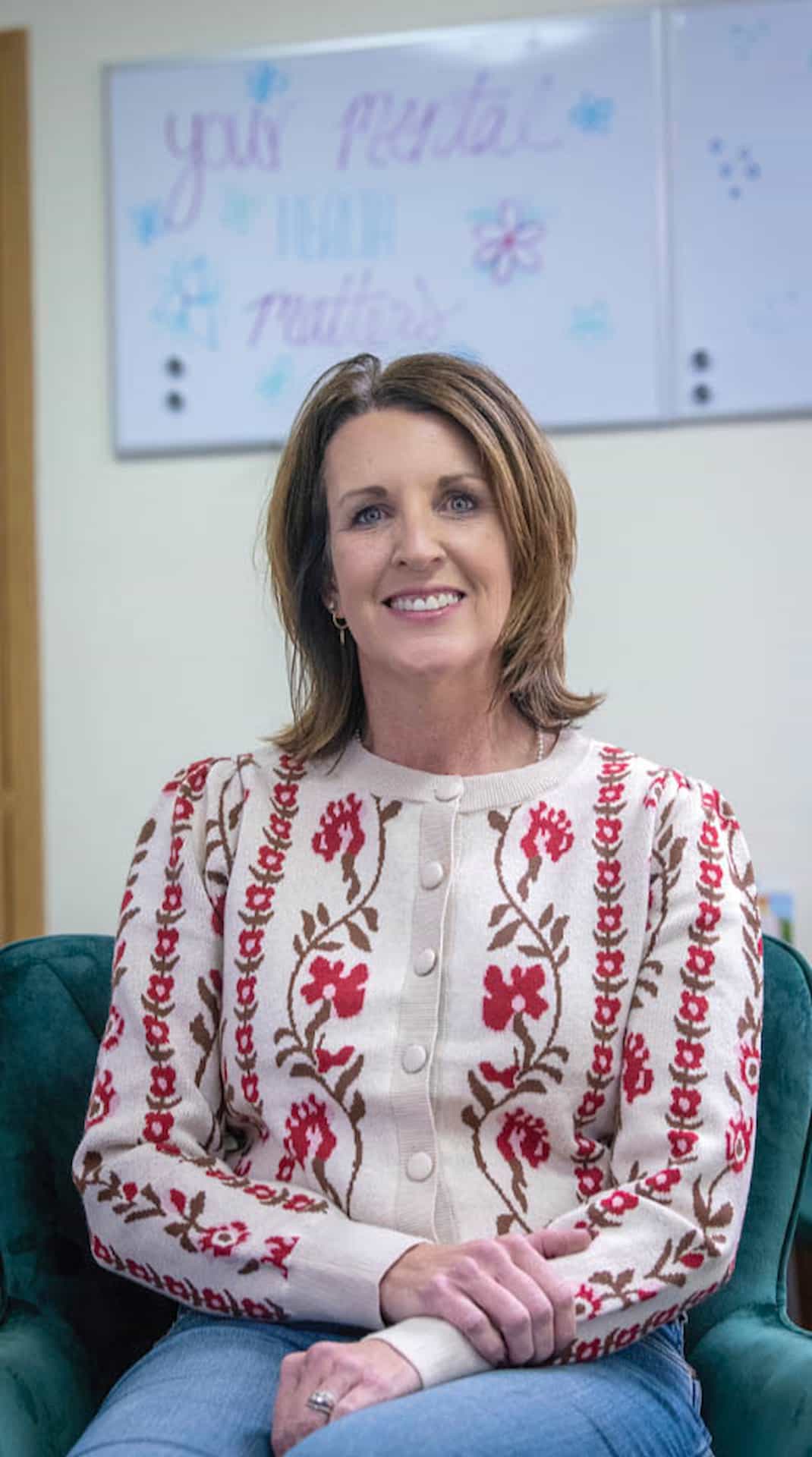
Above – Jolie Foreman leads Shelby County Cares (SCC) as its executive director, helping the nearly 3-year-old organization grow into a robust resource for the communities it serves. Beyond outreach events like Feed the Farmer, SCC is also connecting with both teenage and elderly segments of the population.
CLICK HERE TO READ MORE FROM THE DEC 2025 / JAN 2026 TODAY'S FARMER MAGAZINE
*****
Mental health resources for farmers
Stress is part of farming, but it doesn’t have to be faced alone. When times get tough, knowing where to turn can make all the difference.
“Sometimes just knowing you have somebody to reach out to goes a long way,” said Jolie Foreman, executive director of Shelby County Cares. “It doesn’t have to be for you personally, either. If a family member or friend is struggling, you can call. There are also different help lines that are geared just for the ag community. I encourage anyone who needs it to take advantage of that.”
If you need mental health care or know someone who does, here are some resources to help:
National Suicide and Crisis Lifeline
Call or text 988 or visit 988lifeline.org
University of Missouri’s
Show-Me Strong Farm Families
Free, confidential telehealth counseling by professionals who understand agriculture. Visit
muext.us/PSCFarmRanch or call 573-882-4677
AgriStress Helpline
Free and confidential crisis support by trained professionals who can help you find mental health and agriculture-related resources in your area.
Call or text 833-897-2474
American Farm Bureau’s Farm State of Mind
Information and resources promoting farmer and rancher mental health wellness.
Visit fb.org/initiative/farm-state-of-mind
CLICK HERE TO READ MORE FROM THE DEC 2025 / JAN 2026 TODAY'S FARMER MAGAZINE
Purpose - Full length Video
Learn more about the Missouri farm family turns personal tragedy into hope, breaking stigma around rural mental health and suicide prevention
Free counceling by pros who know Ag