Preparing for what’s ahead
By Allison Jenkins
Farm economy, trade and pest threats dominate discussions at Governor’s Conference on Agriculture
In a year when challenges such as a struggling farm economy, frustrating trade barriers and emerging pest threats have dominated the industry, it stands to reason that those topics would also drive discussions at the Missouri Governor’s Conference on Agriculture.
Speakers shared updates and outlooks that were realistic but also optimistic for the producers, agribusiness leaders, researchers and policymakers who attended the 51st iteration of the conference Nov. 12-13 in Columbia. MFA Incorporated is among the event’s sponsors.
Gov. Mike Kehoe, speaking at the closing luncheon, underscored agriculture’s foundational role in the state’s economy and identity, reinforcing his administration’s focus on strengthening rural communities and expanding value-added opportunities. It was the first Conference on Agriculture for Kehoe in the governor’s role, and he credited farmers for helping him win the election the year before.
“When we talk about Missouri’s future, we must talk about agriculture. Our farmers, ranchers and rural communities don’t just feed our state, they define it,” said Kehoe, who produces beef cattle on his family farm in Phelps County. “Claudia and I count ourselves lucky to be part of this amazing industry, and I’m proud to see Missouri agriculture gather here to look forward and talk honestly about the pressures we face, the progress that’s been made and the promises of the future.”
To open the conference, agriculture journalist and national television host Tyne Morgan recorded a segment of the U.S. Farm Report featuring a panel discussion on the beef industry. Portions of the interview were broadcast the following weekend during the U.S. Farm Report’s regular schedule on RFD-TV. The session’s speakers were Derrell Peel of Oklahoma State University, Bryon Wiegand of the University of Missouri and Lance Zimmerman of Rabobank. The panelists examined the dynamics of cattle numbers, consumer demand, shifts in herd structure, processing capacity trends and long-term profitability signals—all agreeing that the cattle supply will likely continue to shrink while demand remains robust.
“The cow herd has been in decline since the highs of 2019, but per capita beef consumption, which really influences the market prices, is relatively steady,” Zimmerman said. “So, a lot of the price increase that we’re seeing actually comes from the strongest demand we’ve seen in many of our lifetimes, not the supply side, which we expect to keep getting tighter over the next several years.”
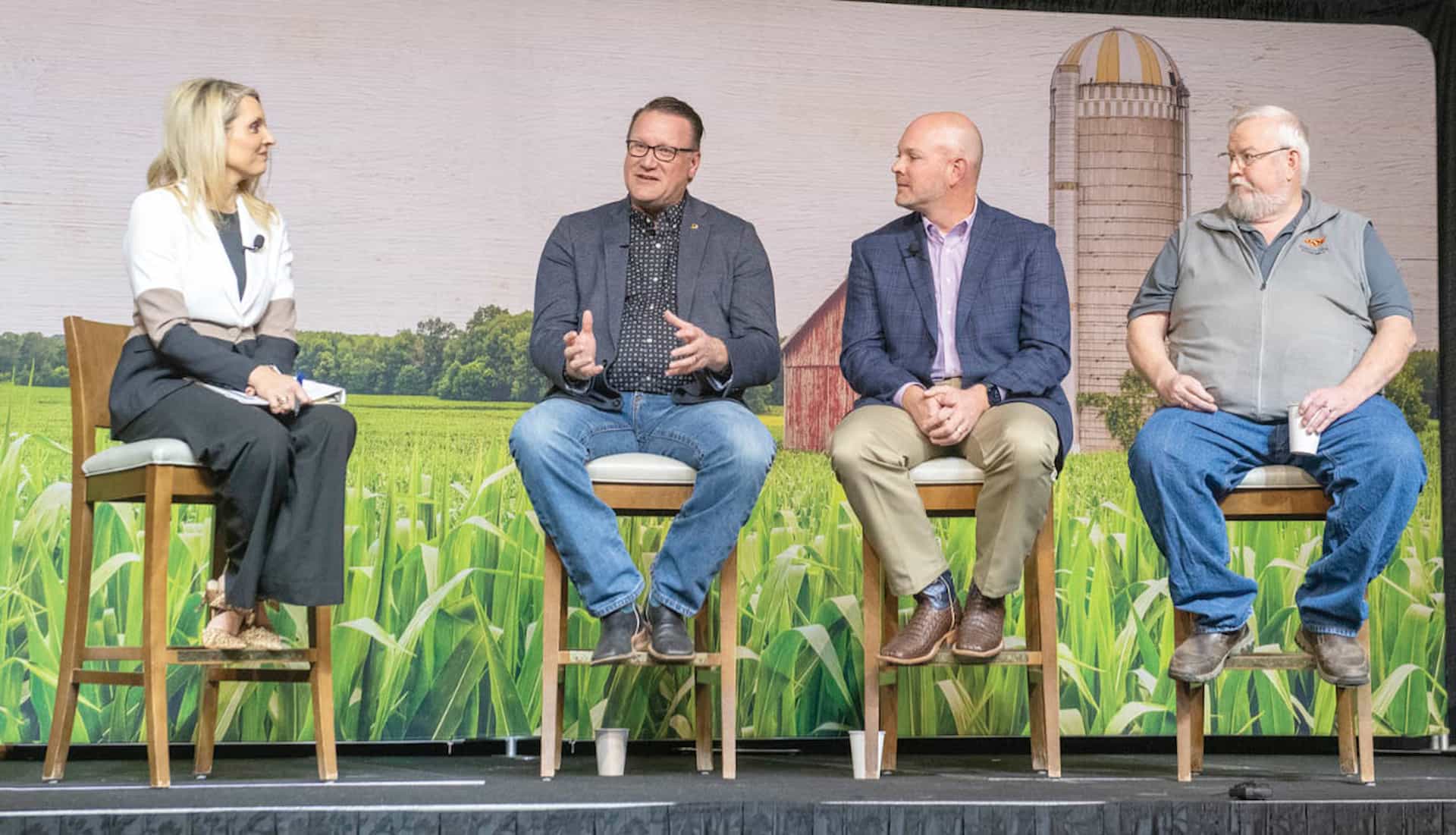 The positive outlook for the beef sector was a theme that resurfaced several times during the conference. International markets and policy volatility were also recurring topics and the focus of an agriculture economics panel featuring Ben Brown of the University of Missouri and Joe Outlaw of Texas A&M as well as another session on net farm income trends with Pat Westhoff of MU’s Food and Agricultural Policy Research Institute and Bill Brooks of Northwest Missouri State University.
These timely discussions delved into the consequences of global tariffs, geopolitical tensions and foreign market access—issues that touch nearly every commodity in the state.
These sessions explained not only what producers should watch, but how those factors could influence profitability and risk management in the coming year.
In particular, Brown said he sees growth opportunity for U.S. agriculture in protein exports and demand for biofuels.
“Whether it’s grain, dairy products or meat, we’re seeing consumption of protein grow and drive demand globally,” Brown said. “We’ve also got bullish recommendations for biomass-
based diesel on the domestic front, with quite a few proposals to turn more of our corn, soybeans and vegetable oil products into biofuel. We’re still waiting on guidance from EPA, but initial proposed rules were favorable to the row-crop sector.”
Along with economic pressures, Missouri agriculture faces looming pest pressures that could affect everything from the state’s timber industry to livestock herds. Rosalee Knipp, state entomologist, identified spongy moth and spotted lanternfly as two insect pests on the radar and provided an overview of surveillance and early detection efforts to keep these invasive species from becoming an issue in Missouri. Linda Lackman, USDA emergency coordinator for Missouri, and Steve Strubberg, state veterinarian, also shared their concerns and biosecurity tips for mitigating emerging threats to animal health.
At the top of their list is new world screwworm, a flesh-eating fly whose larvae infest and feed on living tissue of warm-blooded animals. While eradicated from the United States in the 1960s, this pest has re-emerged in Mexico and Central America, raising concerns about its potential to spread back into the U.S.
“USDA is preparing for a domestic response,” Lackman said. “We’re meeting regularly to discuss planning and preparedness if it were to reach the United States. We’re confident that we can eradicate it, because we’ve done it before, but we have to be active in our surveillance, outreach and education as well as robust control of animal movement.”
Other presentations focused on innovation in value-added agriculture, rural finance and business expansion. One of the most wide-ranging conversations came from the Governor’s Cabinet Panel, featuring leaders from the Departments of Elementary and Secondary Education, Conservation, Natural Resources, Economic Development and Transportation. The panelists emphasized how their respective agencies impact agriculture and rural communities, highlighting initiatives designed to strengthen schools, expand broadband, improve roads and bridges, boost conservation efforts and grow economic opportunities across the state.
Conference attendees also visited with industry representatives at the accompanying trade show and enjoyed some of the state’s signature food and beverage products during the popular “Best of Missouri Grown” reception. The 2025 Missouri Agriculture Award recipients were also honored for their commitment, service and impact on the state’s No. 1 industry. You can see the full list of winners online at agriculture.mo.gov/news.
Across the two-day event, a clear message emerged—while challenges are significant, Missouri agriculture has momentum and broad support from researchers, agencies and industry leaders.
“There’s no sugar-coating these challenges,” Kehoe said. “Input costs are stubborn. Regulations keep coming. Markets shift overnight. And the next drought or flood is never very far away. But we’ve proven that Missouri agriculture doesn’t fold under pressure. It adapts, it endures and it leads. You being here at this conference proves just that.”
Above: U.S. Farm Report host Tyne Morgan, left, leads a beef industry discussion with panelists, from left, Bryon Wiegand, University of Missouri; Lance Zimmerman, Rabobank; and Derrell Peel, Oklahoma State University.
CLICK HERE TO READ MORE FROM THE DEC 2025 / JAN 2026 TODAY'S FARMER MAGAZINE