Grazing the gap
by Allison Jenkins
Livestock can help producers turn cover crops into cash flow while improving soil health
It was the meeting that launched 1,000 sheep.
When Dustin Schuster attended a cover crop conference in 2018, not long after he and his wife, Amanda, started their own farming odyssey, the young farmer came home with an unexpected idea.
“We’re getting sheep,” he told her.
The Schusters were already raising row crops and cattle on their Blackwater, Mo., farm—along with two sets of twin sons and an older daughter—so Amanda’s initial reaction was less than enthusiastic.
“We had so much going on,” she said. “It seemed crazy to start something new, but we did, and it’s been great.”
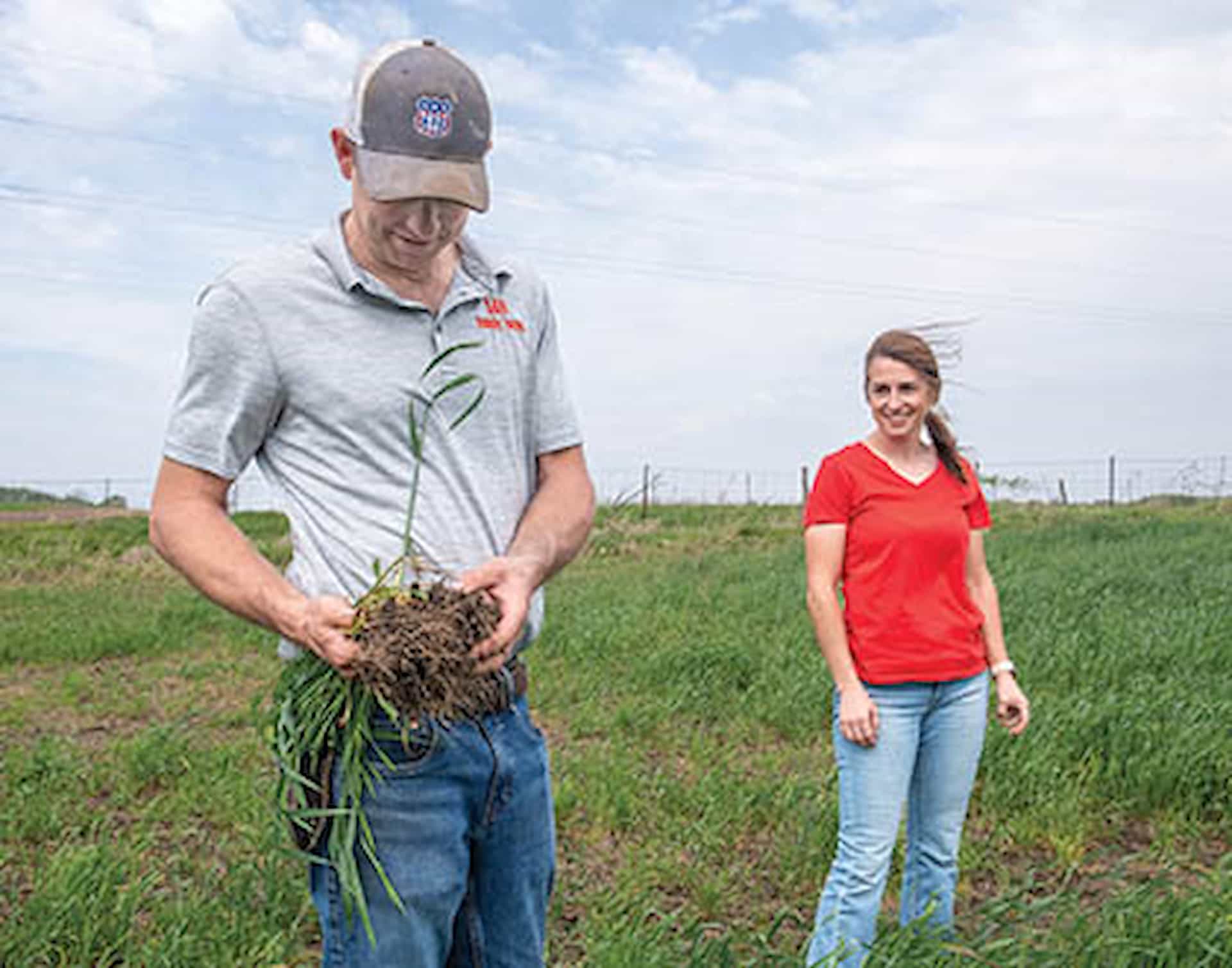 That decision reflects the same entrepreneurial approach the Schusters have taken since building their operation from the ground up. Today, they manage a diversified farming system that uses livestock and cover crops to create an additional source of income in the gap between cash crops.
It’s a journey that’s taken years of hard work, persistence and experimentation. Though Dustin grew up around farming with his father, grandfather and other family members, the operation had largely been scaled back before he was ready to make it a full-time career. He instead spent several years working for a friend’s large row-crop operation, where he helped introduce no-till and cover crops, before launching his own farm in 2015.
On the other hand, Amanda, his wife of 18 years, did not grow up in agriculture. She taught school until 2021, but as the farm expanded, she traded the classroom for the operation’s books—and eventually the driver’s seat.
“We almost doubled every year, so I went from getting out on my own to needing a hired person,” Dustin said. “I told Amanda, ‘If you learn to drive a semi, there’s a job here.’”
“So, I jumped right in!” Amanda said.
Their willingness to try something new became a defining characteristic of A&D Family Farms, which now includes about 1,000 Katahdin ewes alongside 100 head of cattle and 2,000 acres of corn and soybeans.
“I saw a big opportunity with livestock on crop ground and can get almost a three-crop rotation in our system,” Dustin said. “We’ll take 25-30% of our acres out of corn or soybean production, plant them into summer annuals, and strip graze our sheep through the summer. Through the winter and early spring, they’ll go on cover crops behind our beans and corn. And then we’ll plant our row crops where the annuals were grazed the previous summer. My goal is to get livestock on those fields but never have any perennial permanent grass.”
Gaining more than soil health
The Schusters aren’t alone in finding value in grazing cover crops as grain prices have softened and livestock markets have strengthened in recent years. The practice not only provides proven conservation benefits but also reduces feed costs and creates new income opportunities—especially for farms that already have livestock or can partner with other producers.
“We are unfortunately in a time where profit margins are pretty thin for traditional row-crop production,” said Rob Myers, director of the University of Missouri Center for Regenerative Agriculture. “Everybody’s trying to figure out how they can boost profitability, and there is an increasing amount of evidence that grazing cover crops in a corn and soybean system can be a good way to do just that. In Missouri, we’re well poised for this practice because so many people have both row crops and livestock.”
Data from the most recent National Cover Crop Survey in 2023—a project led by the Sustainable Agriculture Research and Education program and the Conservation Technology Information Center—shows 76% of participating livestock producers reported a net profit increase when grazing cover crops. Nearly a quarter of those said profits were between $25 and $75 per acre, while another third said grazing cover crops generated somewhere between $25 and $49 per acre.
“Anytime we can have animals grazing versus having to bring feed to them, it’s about half the cost per day,” said Landry Jones, MFA range and pasture specialist. “And, if row-crop growers are planting cover crops, that’s an expense already figured into their operation. If they can graze those covers, whether through their own animals or partnering with another producer, it makes a lot of sense. If not, they’re leaving money on the table.”
While the Show-Me State has plenty of cattle for grazing cover crops, the Schusters have found that sheep fit well into such a scenario—especially with the current financial challenges of building a beef herd. Plus, the shorter gestation period of sheep allows producers to expand or reduce herd size more quickly as markets change, Dustin said.
“These ewes can have babies in May, and those lambs can have a lamb by the next May,” he said. “Your market lambs are ready six months after they’re born, so you don’t have that money tied up for long. I like feeding cattle, but sheep allow you to respond to the market so much faster. We’ve found that if you have the quantity and the quality, there’s just not enough sheep in this country being raised. The demand is way higher than the supply.”
Adding the animal advantage
The economic benefits may initially attract producers to grazing cover crops, but both Myers and Jones emphasize the significant soil health benefits, including better water infiltration, increased biological activity and improved nutrient cycling. In fact, integrating livestock is one of the five soil health principles promoted by USDA’s Natural Resources Conservation Service.
“When we graze cover crops, we see benefits beyond just growing cover crops alone,” Jones explained. “There is a symbiotic relationship with grazing animals and the way that plants respond. Root systems continuously grow and die back throughout the season, and grazing can stimulate biological activity below ground. Plus, the manure adds nutrients back to the soil.”
After grazing cover crops on their farm, the Schusters have observed these positive changes—and more.
“Our yields have gone up, and our water infiltration rate is better,” Dustin said. “We don’t have ditches, and we don’t have to clean out terraces like we used to. We’ve only been farming most of our ground for seven to eight years, so I feel like we’re just starting to scratch the surface of real soil health benefits.”
Despite the advantages, grazing cover crops does require careful planning and management. Infrastructure, Myers pointed out, is often the biggest hurdle. Many Missouri crop fields no longer have fences, and water access can be limited.
“Fencing is usually the first question people have,” he said. “They don’t want to put permanent fencing around all their crop fields. We have to pay attention to fence laws, but it may be possible to put some temporary electric fencing around the field and then create smaller paddocks for strip grazing. This gives us more grazing efficiency.”
If a cover crop field lacks a readily available water source, producers can haul water to the site using stock tanks or install temporary water lines, much like the system the Schusters use.
“Another benefit of sheep is that their water needs aren’t as intense,” Dustin said. “On a 200-acre farm, if you have one place for them to drink, that’s good enough. The worst part is the fence. People just took out every fence to plant one more row of corn.”
Compaction is also a typical concern for producers who are new to grazing cover crops, Myers said, but can be addressed by having a proper setup with regular rotation.
“The trick is to keep those animals moving rather than letting them loiter around the water tank or having paths that they’re going over and over again,” he said. “Farmers who move their herds regularly are rarely having any issues with compaction.”
New virtual fencing technology holds promise to simplify and drive broader adoption of cover crop grazing, Jones said. These systems allow producers to easily manage grazing patterns, direct animals to water sources and keep them rotated through the fields with less labor.
“Virtual fencing is becoming a game changer,” Jones said. “Producers may not have a five-strand barbed wire fence, but they can put up a one- or two-strand electric fence around the perimeter and then virtually fence in their livestock. As the technology becomes more accessible, it will definitely open up some opportunities.”
Making the system work
When selecting a cover crop species for grazing, Jones said the decision ultimately rests on the producer’s management goals, but most programs begin with cereal rye, wheat or triticale. The latter, a hybrid of rye and wheat, gives producers “the best of both worlds,” Jones said.
“It gives you good leaf-to-stem ratio, grows quickly and stays greener a little longer in the winter,” he said. “Other options, such as turnips and radishes, overwinter well and are easy to plant and establish. Depending on location, oats can also provide a good return on investment versus some other species.”
The Schusters take a practical approach, with a system designed to keep their sheep grazing year-round and moving to different parts of the farm to mitigate parasite problems common in small ruminants.
“We try to keep it simple,” Dustin said. “I know there are all the mixes and blends, but we just put rye on the cornstalks, wheat on the bean stubble, graze it, and move on. With the summer annuals, we’ve had good luck with a combination of crabgrass and red clover. I might do a little more experimenting there. I think there are other things that will work.”
While drilling is the preferred way to establish cover crops, it’s not always practical, Jones said. Broadcasting—by seeder, spreader or aerial methods—can also be effective.
“If you have access to a drill and the labor to run the machinery, then drilling usually has the most success and a little bit lower cost of seed per acre,” he explained. “If you’re worried about time, broadcasting is best, but you need to increase rates one and a half times or more because not all of the seeds will germinate. Luckily, a lot of our cereal grains do OK when broadcast.”
For fall grazing, cover crops typically need to be planted in September and October, Jones said. Turnips and radishes should be planted a little earlier to allow establishment before winter. If producers are more interested in spring grazing, he said, planting can be delayed to November or December, depending location and fall weather.
Once a grazing plan is in place, proper livestock management becomes just as important. Both Jones and Myers encourage producers to pay attention to animal health when turning herds onto fresh cover crops.
“Just like with any high-quality forage, you need to slowly acclimate your livestock to it, maybe give them a bale of hay to eat before you turn them in for the first time, just to get their system prepped,” Jones said.
In particular, Myers added, certain species of forages may have toxicity issues.
“For example, hairy vetch shouldn’t be grazed in a pure stand, but it may work as a minor component of some mixes,” he said. “Also, species like sorghum-sudangrass are generally fine, but, after a frost, we have to be careful about prussic acid, or, after a drought, there are potential nitrate issues. Just be aware of those risks and manage accordingly.”
For producers facing tight grain margins, grazing cover crops may not be a perfect fit for every operation. It requires planning, infrastructure and a willingness to learn new management practices. Yet the combination of additional forage, lower feed costs, improved soil health and extra income continues to attract interest.
The Schusters understand those challenges—and benefits—firsthand. The courage to try such practices is rooted in the pressure and pride of forging their own farming path, and they say that’s why they approach every new venture with a simple question: “Does it pay?”
“Every practice we’ve adopted had to be profitable,” Dustin said. “If I’d never gone beyond my dad’s or grandpa’s farm, I don’t know that we’d be where we are today. Every failure and success we’ve had can’t be blamed on anybody. We get all the credit, good or bad, and that makes us even more determined to make it work.”
Ready to put cover crops to work?
Producers interested in cover crops and regenerative grazing have access to a growing number of cost-share programs and technical resources.
The NRCS Environmental Quality Incentives Program (EQIP) can help fund cover crops, fencing, water systems and other grazing infrastructure, while the Conservation Stewardship Program provides incentives for producers who want to expand conservation practices across their operations.
Missouri producers can also contact their local Soil and Water Conservation District, which administers state-funded cost-share programs for practices such as cover crops, rotational grazing and water development.
For producers interested in virtual fencing, the University of Missouri Center for Regenerative Agriculture’s Heartland Virtual Fence Project offers incentives and technical assistance. Virtual fencing is also a now a component of the EQIP program administered by NRCS. Additional cover crop incentives may be available through Farmers for Soil Health and other private-sector programs.
Before enrolling, MFA Range and Pasture Specialist Landry Jones advises producers to confirm program requirements.
“Most programs do allow grazing, but that’s something to verify,” Jones said. “Even when grazing is allowed, there may be restrictions or specific requirements you’ll need to follow.”
Jones and his counterpart, MFA Conservation Grazing Specialist Cheston Stacy, can help producers plan and manage the right cover crop systems for their operations. Experts at each of the above-mentioned organizations can also provide more information and technical assistance.
Above Photo Cutline: Dustin inspects the rich soil and healthy root system of this clump of wheat pulled from the field where the Schusters’ sheep were grazing in early spring. In addition to the extra income from the sale of sheep, the couple’s operation also benefits from having continuous cover on most of their acreage. With the high price of beef cattle making it economically difficult to add more cows to the farm, the Schusters opted instead to get into the sheep business. They started with 65 Katahdins and seven years later have grown their operation to around 1,000 ewes. Scale is key in sheep production, Dustin explains. “You have to look at 10 ewes as one cow,” he said. “It’s intimidating at first, but you’ve got to have the numbers to make it worth your time and money.”
CLICK HERE FOR CONTACT DETAILS.
VIEW THIS ARTICLE AS PRINTED CLICK HERE
For more articles from the August/September Today's Farmer Magazine, CLICK HERE.