Podcast #106 Show Notes
Virtual livestock fencing systems reviewed
– Made for Agriculture co-host Landry Jones and guest host Joe Zeollner interview two folks with experience using virtual fencing on livestock. Kaitlyn Dozler with MU Center of Regenerative Agriculture’s virtual fencing program talks about use, testing and cost-share programs being developed. Livestock and row-crop farmer Daniel Bonacker from Cedar Hill, MO uses collars on his cattle in his operation and talks about the pros and cons and show how he uses the collar to manage his intensive grazing system. More info on events and product info will be added to the show notes below.
REAL Virtual Fencing - Youtube
Virtual livestock fencing systems reviewed – Made for Agriculture co-host Landry Jones and guest host Joe Zeollner interview two folks with experience using virtual fencing on livestock. Kaitlyn Dozler with MU Center of Regenerative Agriculture’s virtual fencing program talks about use, testing and cost-share programs being developed. Livestock and row-crop farmer Daniel Bonacker from Cedar Hill, MO uses collars on his cattle in his operation and talks about the pros and cons and show how he uses the collar to manage his intensive grazing system. More info on events and product info will be added to the show notes here: mfa-inc.com/realvirtualfencing
Also on Spotify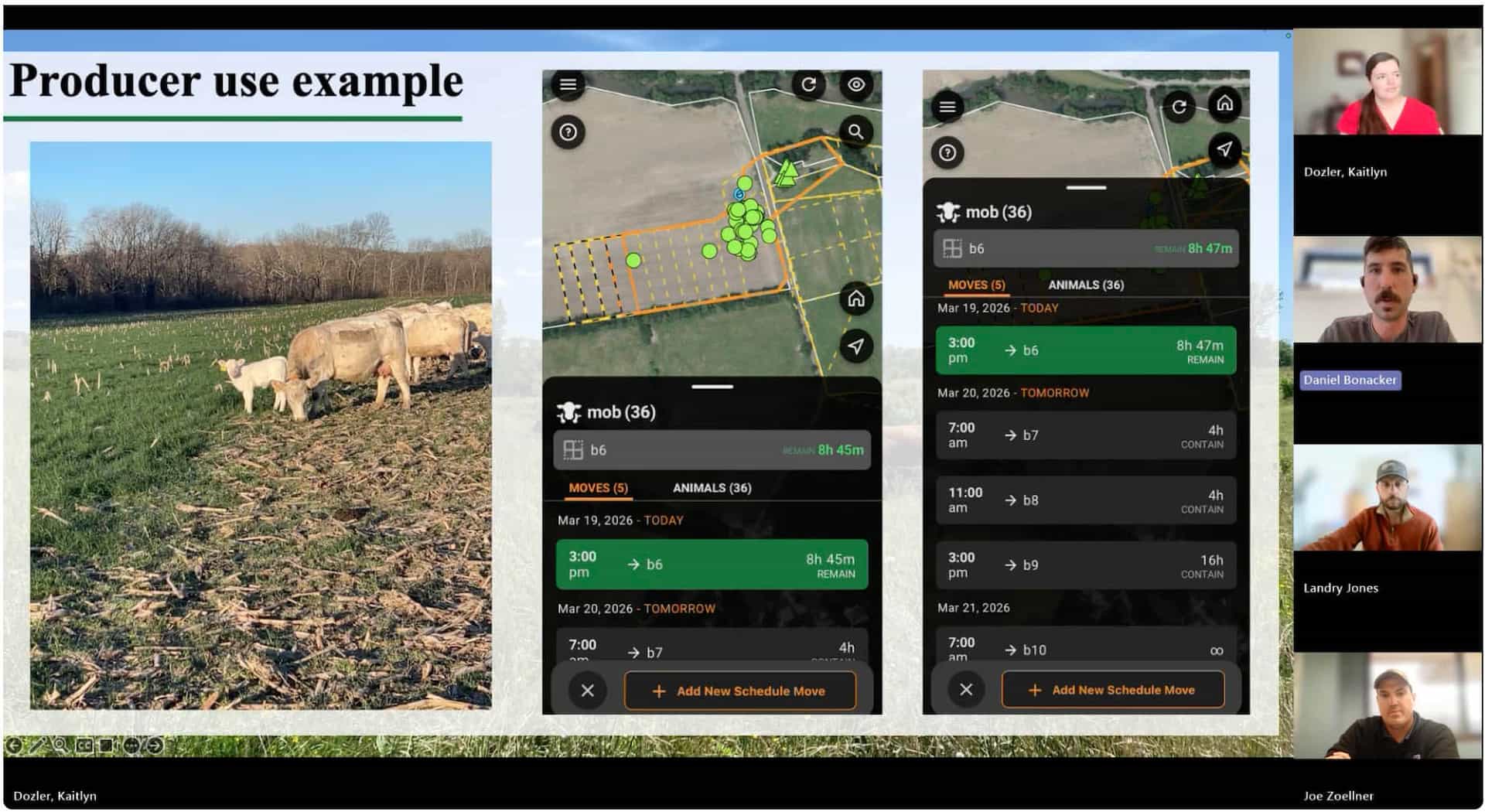
Here is the Podcast transcript created by Microsoft Teams AI:
MFA Podcast-Virtual Fencing-20260323_100247-Meeting Recording
March 23, 2026, 3:02PM
1h 10m 36s
Landry Jones started transcription
Landry Jones 0:09
Hello everyone. Welcome to another episode of the Made for Agriculture podcast. I am your host, Landry Jones, and today we're going to be covering virtual fencing. That is the new, I shouldn't say really a new technology. It's been overseas for quite some time, but it's new to to North America and so.
We've got some folks on here today to talk about that and help bring that information to you. And before we get started, I guess with kind of some questions that I have or before we get into the actual meat of the presentation, let's kind of go around the horn here and have everybody introduce themselves.
I will start with Dan. Dan, if you would introduce who you are, kind of where you're located maybe in Missouri and just a little bit background on your on your operation and and what y'all are doing.
Daniel Bonacker 0:57
Yeah, my name is Dan Boniker. The farm's located in Cedar Hill, MO. That's just South of Saint Louis. Just a little bit. Mainly a real crop operation. Corn, beans, do a little bit of rye and wheat and then we have a registered Charolais herd that accompanies that and.
A lot of conservation practices on the farm, no-till cover crops and in recent years have been working toward animal integration, getting the cattle out on the real crop ground and just improving upon that.
Landry Jones 1:31
OK, great. And Kaitlyn?
Dozler, Kaitlyn 1:34
Yeah, yeah. Hi, Landry. I'm excited for today. This should be a lot of fun. My name is Kaitlyn Dozler. I grew up on my family's cow calf operation in central Nebraska and then went to the University of Nebraska Lincoln for my undergrad. And it was actually during Graduate School there. I got started with virtual fence.
We were the first virtual fencing project in the state of Nebraska and then after grad school I was able to transfer or take the job with the University of Missouri Center for Regenerative Ag, where I now manage our virtual fencing program. And so it's been a really fun couple of years getting to work with the technology and producers across multiple.
States.
Landry Jones 2:15
Great. Thank you. And then last but certainly not least, Joe.
Joe Zoellner 2:18
Yeah, my name is Joe Zellner. I'm the conservation specialist with MFA Incorporated and partnership with NRCS. One of kind of my core competency in my role is to help Missouri farmers and ranchers adopt.
Practices that implement soil, water and wildlife habitat conservation into their working operations. So just kind of been interested in virtual fence from the get-go and I'm excited to hear Dan and Kaitlyn's perspective on. I think you know it's kind of a no-brainer for incorporating livestock into row crop operation or row crop farmer looking to.
Implement managed grazing on their farm.
Landry Jones 2:57
Yeah, yeah, no, absolutely. Well, I will, I guess you know I like I mentioned virtual fencing is kind of new here to to the United States especially Missouri. You know in the in the past we MFA has kind of been looking at or or promoting.
Virtual fencing for several years now, at least kind of when the first company, which might have been Vince, correct me if I'm wrong there, Kaitlyn, it seemed like they were kind of the first on the scene, but they were, they were, and rightfully so, you know, directed their efforts to the western side of the United States where there's large expanses of.
Dozler, Kaitlyn 3:24
Yep.
Landry Jones 3:37
Fields and and grazing lands and that's kind of where it seems like some of the attraction came from or or was and and here within the last couple years you know thanks to University of Missouri and the Center for Regenerative Agriculture really started looking about at.
That technology and how applicable it would be for producers here in in Missouri and obviously our our, I don't know what the average land size for producers, but it's it's quite small compared to out West, right. And so trying to adapt that technology that they kind of designed for out West and and how it would be applicable.
For.
Producers here in the state is what what University of Missouri's been looking at and and also the the companies that are that are in the United States and and available to producers. So I guess with that Kaitlyn, I'll kind of turn it over to you tell folks you know you mentioned the the Center for Regenerative Agriculture but but what are you all doing with virtual fencing kind of when did it start and and what's the purpose of the research that you all.
or doing right now.
Dozler, Kaitlyn 4:36
Yeah, definitely. So the Center for Regenerative Ag Virtual Fence program started in roughly October of 2024. We got a $900,000 grant through the National Fish and Wildlife Foundation to bring virtual fence education to Missouri producers.
Joe Zoellner 4:37
Hello.
Pop up.
Dozler, Kaitlyn 4:52
We really saw virtual fence as a new tool producers could use to really get livestock out on those cover crop fields and crop residue fields and different areas of their pastures they might not typically be able to use due to like physical fence constraints, time, labor, all of those different types of things.
And so the goal of our program was just to get the technology in front of Missouri producers. And we figured the best way to do that was to get it in the hands of Missouri producers. So we have 5 private farms that we work with throughout the state, Dan being one of them.
And then on top of that, we have about four university research farms. And so in total we have just under, I think about 600 virtual fence collars throughout the state in our program. And the whole goal is we want these producers to use the virtual fence collars as if they went out and bought them themselves.
I want to know the great things that happen. I want to know the bad days, and I want to know everything in between with the simple goal of giving Missouri producers an idea of how this technology works on a variety of farms, in a variety of seasons, all of those different types of things before they go and make that financial investment themselves, potentially.
Landry Jones 6:02
Yeah, yeah. No, and I think that's awesome. I mean, you know, with a new technology like this, right, any new technology that comes to producers, especially when when we're asking and I don't want this to sound bad, but it seems like livestock producers are the slowest to adopt technology, right? I mean, our, our, our row crop folks have been.
Joe Zoellner 6:17
Hold on.
Landry Jones 6:21
And adopting technology for for a long time and you know whether it's operation center with John Deere or you know auto steer which you know what I mean like it just seems like they adopt those technologies a little bit sooner than some of our livestock producers do. And so I guess I commend University of Missouri.
To by looking at this technology and looking at it from a wide perspective, right, trying to figure out you know what technology, what maybe companies work better than others and and that may just be based on the management of that operation, right there. I know there's some technology and we'll probably get into this. There's companies that really only kind of deal with or or have the ability.
Daniel Bonacker 6:53
Hmm.
Landry Jones 6:59
To use on small ruminants. So knowing that information that's out there for producers, but also getting folks like Dan and some of the other producers to try it on their farm and to know what works and what doesn't. And I'm sure that's awesome feedback for the companies as well, right? That they've got, you know, one-on-one.
Education with producers to know again what works and what doesn't. And if we can kind of get those bugs worked out on the front side of things, then it's going to be even better adoption for producers when they decide to to take that leap of faith and and really start implementing some of these practices. And so I think again that kudos to University of Missouri for.
For doing that, not only just looking at it from a research standpoint on their own research farms, but allowing producers to come into this to to really kind of get producers perspective. So what companies are, I guess what companies are would be available for producers and then maybe what companies are you looking at if not all of them I guess?
Dozler, Kaitlyn 7:58
Yeah, definitely. So there's there's five virtual fence companies currently on the US market. So you have Vence, No Fence, Halter, E Shepherd and O'Neal. So the important thing just right off the bat, if you're a sheep and goat producer, No Fence is the only company currently serving small ruminants.
Joe Zoellner 8:01
Hello.
The problem.
Dozler, Kaitlyn 8:18
So just kind of right off the bat from that standpoint of it, but on the cattle side of it, all five virtual fence companies are available to producers here in Missouri. With our program, we're working with four out of the five. We're working with E Shepherd, O'Neill, Halter and No Fence.
The only reason we're not working with vents is just simple conversations with their team and stuff like that. Just the high intensity grazing a lot of our Missouri producers want to do. Their collars are more designed for kind of the robust out West grazing systems versus the high intensity grazing systems here in Missouri. So they're not in our program, but.
It's always an option for producers if that's something that they want to go with.
Landry Jones 9:01
Cool. And I guess let's kind of get into the the technology side of things. I mean, I know and we could, we could probably make this podcast 4 hours if we needed to, but I guess kind of tell producers or tell listeners.
You know, is there some, is there major differences between the technology and then when I say technology as far as like the collar itself, I mean it seems like most of the companies have a similar platform and you can get into that as well depending on you know whether we're using cell towers or or we have a stand-alone.
System based tower type system, but I guess just kind of walk through folks what the what the technology is, how it is applied to the animal and then how the producer interfaces with that technology.
Dozler, Kaitlyn 9:49
Yeah, definitely. So the easiest way I describe the technology to producers is think about it like shot collar for your dog except on a cow, sheep or goat type of situation. And So what you're gonna do is you're gonna pick the company that you want to work with. All of the companies have the same kind of baseline technology the collars run off of.
Sound and shock stimuli. So it's a GPS enabled collar. The collar knows where those livestock are at at all times. And basically you, the producer or Dan in this case, would go in on his phone or computer and draw those virtual fence boundaries just with the click of a mouse or just by pointing and clicking with your finger the different shapes.
And those GPS coordinates are sent to the collars on those animals and those virtual fence lines are established. No bearing wire, nothing of that sort of things. And then when the livestock start to approach those virtual fence lines, they're going to 1st be met with like a really high pitched beep.
And you train the animals to know that sound, and that's their cue to stop, turn around and go back. They're not supposed to go any farther. If you have a stubborn cow or something of those types of sorts, and the cow decides to go beyond that virtual fence line, that's when she's going to be met with that electrical stimulus.
The electrical stimulus, it's less than what a typical electric fence is strength wise and cows can only be shocked up to three times before the system cuts out for like animal welfare safety from that standpoint of it. And all of the companies run all those kind of basics of the tech, the major differences.
You might see between companies are whether they're cellular based. So if they run over the same system as like your cell phone would where that's kind of Dan's case, I always say like as long as you can send a text that there's a good chance that the system will work in your area just fine. And we could be sitting here in Missouri and managing cows out in California if those cows are.
Within cell range, which is just really crazy to think about. And then in situations where cell service might not be the best or just in general, some of the companies require towers for their technology to work and so tower or base station, you hear it referred to both ways. It basically just acts as a relay point and so.
The callers talk to the tower and then the tower talks to the nearest cell phone tower or Wi-Fi signal, just kind of relaying that information. And so those are sometimes probably the two biggest differences you'll see between companies besides just little feature upgrades, little design differences, things like that. But that's kind of the basics on how it all works.
Landry Jones 12:19
Yeah. And so I think I know the answer to this question, but just maybe to to clarify, you mentioned if they have the cell phone company or the company that offers a cell phone plan that they could manipulate their grazing events.
Obviously virtually away from the farm. If they were staying on vacation or something like that, I would assume the same as if they have the towers, they still they don't have to be close to that tower to to manage those fences, do they? No, right?
Dozler, Kaitlyn 12:42
Yep.
Nope, not at all. So like, yeah, like big ranches and stuff like that. You could potentially have 6-8 towers out on those ranches and just the cows have to be within range of the tower, but you, the person sending the commands, do not.
Landry Jones 12:58
Yeah.
Yeah, yeah. And then when what, I guess look folks, what company you're using, but also.
Are you using the base towers, the base stations, or do you or you have a the the cell phone?
Daniel Bonacker 13:17
I'm using the cellular version of the Gallagher E Shepherd colors. Yep, I got. I've got great cell service here, kind of my proximity to Saint Louis. We have quite a few cell towers, even though we're somewhat rugged and our terrain hasn't been an issue.
Landry Jones 13:22
OK.
Daniel Bonacker 13:33
At all, like Kaitlyn said, as long as you can send a text, so it doesn't even have to be that good of cell service. And one thing I think a lot of people maybe don't realize is the collar doesn't have to maintain cell service the entire time. It's that's just the commands you're sending it. Otherwise it's linked to the satellite with the G.
GPS location. So once that boundary is established, it's sort of tied to the collar, not necessarily tied to your phone. So the the collar is just communicating with that boundary you give it after that. So the the cell signals just for pushing information or.
Dozler, Kaitlyn 14:00
Mhm.
Landry Jones 14:01
Hello.
OK.
Daniel Bonacker 14:10
Seeing information, you know, looking at the location of the cow.
Landry Jones 14:14
OK. OK. So I guess the question for both of you then is, you know, say you've got, say you've got a a cow or or a few cows that are potentially on that edge of of having that cell phone signal if you were to make a change in that.
Virtual fence that you say you wanted to move animals and those cows were down at the Creek bottom and didn't have that cell signal. How? How would that work? I guess maybe Kaitlyn or do those animals not get that that that notification to move or whatever it might be and the rest of her does or does it wait until all the animals are in?
Self sell signal to to make that move there that change in the fence boundary.
Dozler, Kaitlyn 14:54
I was like, Dan, do you want to take that from kind of your producer perspective?
Daniel Bonacker 14:56
Yeah, yeah. So whenever you give it the herd, a new paddock, it waits for every caller to communicate with the system. And yeah, that's been kind of an interesting learning curve, the Gallagher said, like a 10 minute update rate.
Landry Jones 15:04
OK, OK.
Daniel Bonacker 15:14
Well, like you said, some callers may not be communicating or be out of range. So that 10 minutes becomes 20 or 30 sometimes because it it waits every 10 minutes to see how many callers it can communicate with and then it does another 10 minutes and so.
That's one thing it's taken me a little time to get used to is that you give it a new paddock. It takes a little while sometimes.
Landry Jones 15:38
Yeah, does it? Does it send you? Does it send you a notification when that paddock change happens? Or do you know once all those animals get within cell signal, then you get some sort of a notification that that they've moved or that that boundary's been been dropped and a new one in place?
Daniel Bonacker 15:38
But Brian, it.
Yes.
Yep.
Yeah, yeah, it tells you when the new paddock is activated. And there's a you can look on the app, there's a status of the paddock update too, and it sort of loads like a loading bar, you know, say 95% ready. And that's basically means you the systems communicate with most of the collars, just not all of them yet.
Landry Jones 15:54
Yeah.
OK.
OK, huh.
Dozler, Kaitlyn 16:13
Yeah, and if livestock ever go in like a quote UN quote dead zone, it's not like the collar stopped working. Like Dan says, the previous virtual fence is still uploaded on this collar, so those cows will always be contained. It's just receiving their new GPS location or receiving that new kind of push of information won't happen until they walk back into cell service.
Landry Jones 16:33
Yeah, that's good to know. You know, and I like I said I I heard you talk Friday, Kaitlyn, at a conference and and that was one thing that I'm sure myself and other producers that that don't have virtual fences. But you know whenever we start putting our faith into technology, we.
Daniel Bonacker 16:34
Yep.
Landry Jones 16:51
Technology fails at some point, right? Whether it's a short amount of time or or a large amount of time, there's always some failures in technology. And so that was a concern that I had is like if if you lose, say, a base station or if you lose a cell phone, you know, say a tower goes down or whatever.
Are those cattle now just out roaming wherever there's now a hard boundary like a electric fence or a hard electric fence or a or a barbed wire fence? So but you're saying that you know if we if you lose that signal or if we lose something that those animals are still confined to that one, the old paddock kind of that you had set up, right?
Dozler, Kaitlyn 17:28
Yep, and I think it's roughly like a 24 hour, they call it like emergency fence type of situation. So if the system does go down, your cows are contained to that same virtual fence for 24 hours to give you a time to like get a plane together if for some reason the system doesn't come back online by that point.
Landry Jones 17:29
Right.
Daniel Bonacker 17:48
Yeah, we've we've had some of these issues where there's we've lost communication with the collars, but they work. Gallagher at least I know works 24/7. They have a New Zealand team and they have AUS team and and.
Landry Jones 17:48
Yeah.
Daniel Bonacker 18:03
Like we were down on service one time and they were working as quickly as I could to get that back up and going so we could move cattle.
Gave me a little bit of Peace of Mind.
Landry Jones 18:13
OK.
Yeah, absolutely. Especially like you said, if you're on vacation, you know, for a few days and I mean that again, that's our biggest fear, whether we're using virtual fences or our barbed wires at the count, we're going to get out of our fences, right. And if we're putting all our faith into, you know, my phone or or a tablet or something that that is not now a physical boundary, you know?
Daniel Bonacker 18:22
Uh huh.
Landry Jones 18:35
Making sure that that nothing goes haywire while you're on and and so that's yeah that's I think that's that's something that I was unaware of.
Daniel Bonacker 18:39
Yep. And there's still, there's still a place for the permanent fence around whatever farm the cattle are on. That's absolutely necessary. Like Kaitlyn said, the shock stimulus that gets really not that powerful, not compared to a.
A fence charger on a high tensile wire. It's not even close. And so yeah, I wouldn't feel comfortable running this without a permanent fence. You know, at least keep them on farm and there's still a place to get out the the.
Polywire reel and step in post too for making moves and different things. That technology is still going to be useful too.
Landry Jones 19:19
Yeah, yeah. And I and no, I was gonna. You're probably gonna answer the question I was gonna ask. So go ahead.
Dozler, Kaitlyn 19:20
Definitely. And I will say, oh, sorry, Landry.
Oh, I was just gonna say some of the companies do incorporate Bluetooth onto their collars. It's a really cool system. So like if one cow or one cheaper goat like is in cell service and they get the new command, they can walk into the area without cell service and their collar will connect via Bluetooth to all the other collars in the herd.
And transfer those new messages and kind of those new paddocks and things like that. And so that's something that some of the companies have currently and I think a lot of them are kind of working towards from that standpoint too, to keep the herd more connected.
Daniel Bonacker 19:58
Well, that would that would connect the producer to the collar too. They would be able to walk out in the herd and maybe turn the collars off or you know, a little bit of failsafe. You're not relying on cell signal.
Dozler, Kaitlyn 20:06
Mm.
Landry Jones 20:14
Right, right. I guess another question real quick and then Joe, if you've got any, I'll let you kind of ask them. But you know, another concern again, I'm just kind of thinking through this on my own heard, you know, I'm sure producers have other, well, I know they do because I've heard them ask questions at at conferences, but.
You know, if a, say, an animal goes past that boundary that you've established, whether it's, you know, whether she's just ornery or she's, you know, there's issues with predators or whatever it might be kind of, I guess Kaitlyn walk me through that process, you know, or do they they keep getting shocked as they leave that boundary?
Or is there, do they have the ability to get back inside? And then how does that work? I mean, I guess just kind of walk me through that scenario if that was to happen.
Dozler, Kaitlyn 20:56
Yeah, definitely. And so typically if a cow goes across that virtual fence line, like we said, she's going to get shocked up to three times and those shocks are going to continue. Like as she leaves the paddock, she'll continually get shocked. Or if she stops, she'll get shocked is like her sign, like, hey, go back.
Type of a situation. After those three, what'll typically happen is the producer would receive a notification on the app or like be a text cow 234 walked out of the boundary. And so nine times out of 10, if it's one animal, she's going to stick close with the herd due to those herd instincts and she'll be able to walk back into that virtual fence.
No problem. It acts as a one way gate. She's not going to get any type of stimulus or cues coming back in with the herd, and then the system will recognize she's back in, her collar will turn back on, and if she tries to leave again, she'll get those cues again. The other option is simply I tell producers, OK, your cow gets out, you go into your app, you hit edit.
You draw a couple more virtual fence posts and you hit save and then she's technically back in the fence. So those are kind of the two different options I typically walk producers through. But Dan, you can kind of talk on that from like your cows a little bit.
Daniel Bonacker 22:06
Yeah. So yeah, I've seen where I haven't had where a cow gets pushed by a predator or something, but you know, you'll have that problem, some cow or something that likes to go, you know, ahead of the group, the fresh grass and yeah, she'll get hit a few times and then, but they'll just sort of hang out close to the herd and then come back in, so.
Really not a lot different than a physical fence, but actually probably easier for them to get back with the herd because they don't have to jump a fence or something, right? And then like Kaitlyn kind of mentioned, drawing a paddock to contain that one that's out the.
Dozler, Kaitlyn 22:35
Right.
Daniel Bonacker 22:43
Kind of the first few times I used it, just getting comfortable with the system. I would have my small paddock made that I wanted them to graze for that day. Then I'd also draw a big one around the whole pasture that I could kick on. Like if if the group did get out or something, this made me feel a more comfortable I could.
Get the notification. Go turn that on right away. You know this game, but now I'm more comfortable with it.
Landry Jones 23:10
Yeah, yeah.
OK, well, I mean, like I said, I um.
You know that there's there's going to be hurdles in any of this new technology and and the whole virtual fence thing is is something that that I know a lot of producers are skeptical of. I I think it really opens the doors to changing the way that that we've managed our our grazing operation in the past, right.
When I talk with producers about rotational grazing, the the biggest.
The biggest thing that comes up on why maybe they don't want to do it is one, they don't have the time and two, they don't have the infrastructure. They don't want to mess with Poly wire and unreel and reels and moving that you know and if you can talk somebody into doing that and splitting a a pasture into two pastures with with Poly wire or however many that we can get them talked into, it's.
I don't have the time to go out there and move cattle. So I'm going to do it maybe once a week. Maybe I'm just going to, you know, set up a paddock I'm moving on Saturday and Sunday when I'm off, you know, off work from my regular day job. And so I think this really opens the doors to to have producers be able to really.
Intensely manage their grasses the way that that way that we've kind of always hoped that that producers would. That being said though, you know, I guess what are some and I'll maybe throw this to you, Dan, obviously been working with it for a while. How have you seen it working?
Work on your operation it's like like what has changed since you've implemented these virtual fence collars and and are there are there still some things that you're skeptical of or things that that you know you're maybe if if if we had a Gallagher Rep here with us today what were what would be some things that that you would say hey this is not quite there yet.
We maybe we need to work on that before I kind of go both feet in.
Daniel Bonacker 25:07
Yeah, Landry, I'll, I'll answer the first part on kind of how I've seen it change and then we'll go into maybe some of the problems I see with the system currently. So kind of we've had them since September and getting into it now a few months, labor is everything you kind of hit on that the the ability.
To manage your grazing with less time, the labor's the game changer here with these collars and I think that's how producers are going to figure out how to make it pay on their operation is not not necessarily in grazing management and more utilization of forage and better utilization, but the labor savings.
That's where the real dollar is going to come back to the farm. Obviously better utilization of your forward is going to pay too. But I think in my opinion, got to look at this from a labor standpoint because it's it's not too expensive for the.
Poly wire and step in post tech and be able to manage that way and that's how I was doing this prior. But we've we've really you know kind of expanded this labor side of the farm. You know I'm I'm already thinking you know.
Just me as an individual, how many more cows I could run, how many more farms I could run. And like one thing that the Center for Region really wanted to look at with these collars is how you can run cattle on crop ground and and it's, you know, it's really got the wheels turning here. I can like.
Landry mentioned I went on vacation last week and I was actually out of cell service the entire time we were down in southern Missouri. And so I set these cattle up on a schedule. They got moved every four hours across the cereal rye and and it was corn stalks from last year.
And you know, I I would have had to have, you know, paid somebody or had a family member come roll poly wire up every four hours to get that kind of utilization, that usage out of that. And that's, you know, that was a quick easy.
You know, labor solution there to just set them up on a schedule. I had the Peace of Mind while I was away with my family that, you know, I knew where the cattle were at for one. You know, if I came into cell service, I could look at the app and then I I would have never achieved that sort of managed grazing like that.
You know, without boots on the ground. So labor is huge. Um.
Cause I don't, I don't think these collars are gonna change the way I was managing my grazing high intensity, you know, short-term high intensity grazes followed by long rest periods. Those principles still you know are are in place. It's the the time it takes me to go implement those principles, right?
And so diving into the second part of your question, what like if I had a Gallagher Rep here, what would I ask them? There's there's been one thing that Kaitlyn and I have kind of expressed this change we want, but when I look at managed grazing, you know I'm.
Measuring my forage or taking account of the forage that's ahead of the cow for the next day or the next 4 hours. And I kind of know and I know an area. You can measure the forage and determine an area that the 30 cows need for that day, right?
Um.
That area is not real clear in the system that Gallagher has set up. When you draw a new virtual paddock, it's not that easy to see what that acreage is, you know, of the new paddock and for me when I go to.
When I go to move them, I'm not always moving them on a schedule. I go walk out there. I see how they grazed the day before. I'm looking at the forge that's ahead of them. You know, did they leave enough behind? Did they trample enough? And so I need to make quick adjustments like I did with my poly wire. Sometimes I'd move that.
Front fence either forward or backward a little bit to give a little more or a little less area and I would was doing that in another pasture management app and I could very quickly see what that area was while I was standing there. Not as simple, not as straightforward in the Gallagher app currently. I'm sure they'll make that change but.
Landry Jones 29:12
So.
So you're saying you're so you're saying when you when you set that boundary, it's not, it's not displaying how many acres that is. And that's what like if you're going to give them a 10th of an acre one day and and you realize that that wasn't enough and you wanted to give them 2/10 of an acre the next day when you make that new pasture, that new.
Daniel Bonacker 29:16
Go ahead, Lane.
Mhm.
Landry Jones 29:35
Paddock it's not allowing, it's not. It's not saying that this is 2/10 of an acre. You're just kind of going off of the the visual reference.
Daniel Bonacker 29:45
Right. So what's a little bit tricky is you have to incorporate the last paddock in the new paddock, so the cows.
Are are included in the new move. So you basically just imagine, imagine if you did it with poly wire, you'd have your current paddock and then you take another piece of poly wire and you make a bigger circle around them, right? That's how you have to kind of draw it out on on Gallagher's app currently and when you draw that.
Bigger area outside the smaller area that they were currently grazing. That difference isn't very clear and it's more clear on the desktop version and you can kind of see better on that. But when I'm managing my grazing, it's boots on the ground, right? And.
Landry Jones 30:21
With it.
Daniel Bonacker 30:30
I'm I'm standing in the herd. I looked at how they grazed and I I'm looking at the forage ahead of them and I kind of want to do this on the fly. That way I keep my adaptive grazing the way I want. You know, this could very easily be set up to where you don't look at your cows every day.
I'm I'm I'm trying very hard with this technology to still be out there every day like I was when I was rolling up Polywire. So I I would like to see the app be a little more functional in the field and you know to use it more that way.
Landry Jones 31:02
Sure. Yeah. Yeah, absolutely. No, absolutely. Well, and I think you hit a lot. Go ahead, Kaitlyn.
Daniel Bonacker 31:03
Does that make sense?
31:06
I think.
Dozler, Kaitlyn 31:08
Oh, I was just gonna say, I was like, I think this would be a good time to pull up the moves and let Dan kind of explain kind of what he was doing with the hour, 4 hour moves and stuff like that. If that's cool with you, Landry, I can pull that slide up, yeah.
Daniel Bonacker 31:18
Yeah.
Landry Jones 31:20
Absolutely. Yes, please do. Yep.
Daniel Bonacker 31:23
I can use it to explain than me describing it.
Dozler, Kaitlyn 31:33
I was like, can you guys see that?
Landry Jones 31:35
Yeah. Can you, can you enlarge it just a little bit?
Daniel Bonacker 31:36
Mhm.
Dozler, Kaitlyn 31:37
OK, perfect. Yep.
Daniel Bonacker 31:40
Anybody?
Dozler, Kaitlyn 31:46
We'll see. There we go.
Landry Jones 31:48
Perfect.
Dozler, Kaitlyn 31:48
Sweet.
Daniel Bonacker 31:50
Yeah. So what we're looking at here is my spring cows calving right now and I've got them out on the cereal rye and corn stalks. And so this was when I was gone on vacation and they got this new area every four hours.
And I did this in the desktop version when you set up your scheduled moves and I just kind of determined an area just based off experience of grazing these this rye at this stage and yeah, you can kind of see.
The yellow lines are the previous boundaries. The orange is the current one. Then there's some bolder like striped lines out ahead of that group. There you can see toward the left of the screen and so this this kind of shows how.
As you're moving forward and this is going to be a little different than in a in a like a perennial pasture where I don't want them to bat graze. In this situation there's a bat graze going on. They're going back to water, not real concerned about regrowth.
In this annual forage here, but you can kind of see how every move you'd incorporate the herd into the new move. You wouldn't. You wouldn't necessarily just draw a teeny little quarter acre.
paddock out ahead of them. You have to incorporate the whole herd in that move.
Landry Jones 33:16
Right.
Daniel Bonacker 33:18
It's a little to me, it's a little clunky doing it that way. I'd I'd rather just draw a new Polygon ahead of them, not worry about.
Landry Jones 33:19
Yeah.
Daniel Bonacker 33:29
To make it easier going into this, you know, graze and perennial pastures this summer where I don't want them to back graze or I'm moving water with the herd. It'd be nice if I didn't have to to include that old paddock in the new paddock, but.
Landry Jones 33:44
Right, right.
Daniel Bonacker 33:45
I am hopeful that Gallagher will will change that. I Kaitlyn probably knows better than I do, but I think halters is sort of set up a little differently where that new paddock is you don't have to include it, it just has to be touching. Is that right?
Dozler, Kaitlyn 33:58
Yeah. Yep.
Yeah.
Daniel Bonacker 34:02
To me that would be a little little easier to to manage. I don't know if I'm explaining this the best, but that's that's the big issue I see with really really putting this into an adaptive grazing system where I'm I'm moving quite frequently and I don't want any any back grazing to occur so I get my good rest periods.
Landry Jones 34:22
Yeah. Are you? I was just gonna say real quick, I looking at you said you're cabin right now, Dan, is that right?
Dozler, Kaitlyn 34:22
And I think.
Daniel Bonacker 34:29
Yep.
Landry Jones 34:31
Have you have you had any issues and I when you when I saw your picture there it made me think of some issues that I've had with like single strand hot wire fences and and calving next to those and where those calves would new calves like two or three day old would go and lay underneath across the electric fence from.
Daniel Bonacker 34:45
Mhm.
Landry Jones 34:50
Where the Mama was and the Mama couldn't get to him. I've had some predation issues. You may not in, you know, in a wheat system like that or in an annual crop like that may not be an issue, but have you seen anything like that or does that concern you in any bit or even when these?
Daniel Bonacker 34:53
Yep.
Landry Jones 35:06
Cabs get older, you know those cabs like to run and play, and if they're going to get outside of that boundary, is there any concern with maybe not having those animals tagged or or collared or being able to control them to some degree?
Daniel Bonacker 35:19
Yeah, yeah. So first part of your question, new baby calves on the ground. Yeah, kind of like you do with a single strand wire. You go out and check your cows and you, I kick those calves up and kind of get them to go back with mom. I had a couple cows this year.
You know where I would tag that calf within the first few hours and that sometimes the calves take off running after that. I've had a couple cows follow them through the virtual fence, just follow their calf and maternal instinct took totally over the those cows took that shock.
Landry Jones 35:46
Hmm.
Daniel Bonacker 35:53
You know the three shocks and they just went on cause they were going to follow their calf no matter what. So that that was a kind of a little learning deal for me. I I figured out that I probably need to give them bigger area while they're calving and just to to make them more comfortable and just be kind of aware of.
When I'm tagging him or where I'm tagging him, maybe so I don't just force that cow to. I don't want her to get shocked. She doesn't have to right the animal husband coming in here. So that was a that was a learning moment for me moving into later in the season as the calves get bigger.
Landry Jones 36:21
Right.
Daniel Bonacker 36:31
When I was making moves every day with a single strand of of poly wire, I was fine with the calves scooting under that and getting ahead of the cow and getting the the best forage ahead of that, you know, call that creep grazing, right? So I see going forward this summer.
Landry Jones 36:44
Mhm.
Daniel Bonacker 36:47
I don't see that being an issue at all. And there'll be times where I'm going to have to get the the reel and poly wire out and contain some cabs, right? There'll be some areas where I don't want them to go. And so there's you're still going to have to get out the old technology, right?
And make it work. This is just kind of a tool within your operation is the way I'm seeing it.
Dozler, Kaitlyn 37:11
Dan, can you tell them about some of the cool things you've been using the virtual fence for for calving, like telling when a cow is calved and tagging them and stuff like that?
Daniel Bonacker 37:18
Yeah, so super cool. So yeah, let's look at this picture. Let's just say that cow on the far left, you could probably just take a guess that she's calving, right? She's if I open up my app and I look and I see that 8114 is hanging off by herself and I, you know.
Let's just say one one night, one instance, it was about 910 o'clock at night. I noticed a cow off by herself and I knew she was close to calf. I'd seen her that day. And so I could pretty much guarantee that when I get there in the morning, there's going to be a calf on the ground. So I went ahead and wrote my tag out for that.
That cow and that calf and walked right up and tagged that calf the next morning. There was no approaching the cow first, seeing what tag number that was, going back to the truck, writing the tag out. You know, that was kind of a neat thing that when we collared these cows in September, that hadn't even dawned on me that I could use these.
Collars for that. So I thought that was pretty cool. I was a little more of a low stress way of of tagging A calf because as you know, sometimes you go check out the cow to find out what tag number she was and she picks up her calf and leaves, right? So.
Dozler, Kaitlyn 38:26
Yeah.
Daniel Bonacker 38:27
It a little time saver there, a little lower stress on everybody and I've done that quite a few times. I've I found the cow on the app that's off by herself and went ahead and had the tag rode up before I got there.
Landry Jones 38:42
Yeah.
Well, I think you know.
One of the you kind of mentioned it earlier, Dan, but you not push back, but one of the concerns that that I've heard from producers and rightfully so is that this technology is going to take away from that.
Being out there every day or or every couple days to manage your forage and and and taking those observations whether it's from a forage standpoint or for an animal health standpoint. And I think I think people, I think people have to realize that you know obviously this this technology would allow you to do that right if if you know it may even give you.
Daniel Bonacker 39:13
Mhm.
Landry Jones 39:22
The.
Depending on your on your situation, this may allow you more connection with your animals than putting them on a piece of rent ground that you only see once a week, right? At least you would know. We at least you'd know where they were at if something something got out. But I think that the key is to be to use this as just a tool in the toolbox, right?
Daniel Bonacker 39:31
Mhm.
Landry Jones 39:42
And allowing you that opportunity, you know, you mentioned lower, low, less labor involved, which is obviously a good thing. But I think that Peace of Mind being able to get away and spend some time with the family on a vacation and not be stressed out that you know what's going back, what's happening back on the farm or happened.
And to have somebody happen to have a family member or a hired head, keep an eye on things while you're gone. You know, you can do that now. So I think that's huge for cattle producers because as we know, cattle producers don't like to leave the operation. They don't want, they don't like to be able, you know, to to be away.
Especially during during times where they feel like they need to be there. So I think that's huge. The other thing is just the small things like I've heard Kaitlyn talk in the conferences that I've attended with her speaking. You know, I know some some of the companies have LED lights that they can turn on or that the producer can turn on to to.
You know, single out an animal, kind of that same situation. If you had one cabin or if it was heifers, you need to go out there and check that that animal, you can turn that that light on or whatever and really pinpoint that. I mean just little things like that that in turn give us Peace of Mind that make it.
Make our operations a little more easily managed, I think are huge and somewhat overlooked. I mean, I know there's, I know there's an economic ROI to these from you, you know, for more utilization of our forages and less labor the costs of labor. But there's a lot of things on the backside that that we kind of forget about or we may take for granted as cattle producers.
And this, this really just kind of opens up the ability to to do things differently, not only from a forge management standpoint, but just from an operational standpoint, so.
41:25
Mhm.
Daniel Bonacker 41:27
Yep, you nailed it.
Dozler, Kaitlyn 41:27
I always say, yeah, I was gonna say, I was like, I always say producers' imagination is kind of the limit when it comes to the technology. Just watching producers like, yeah, how Dan's figuring out how to utilize it during calving season and stuff like that. It's so much fun to hear that. I tried this new this week. Oh, this worked this week. Like, I'm gonna try this next week. Like, it's so much fun to just.
kind of see the progression and how the producers are using it and like how it's growing all over the state.
Landry Jones 41:53
Yeah, yeah. No, I I think it's, I think it's awesome work that MU is doing and like I said, getting getting this technology into producer hands and really letting them experience what it would be like if they were, you know, if they had this system on put in place. Dan, I guess just looking at this picture on the left here.
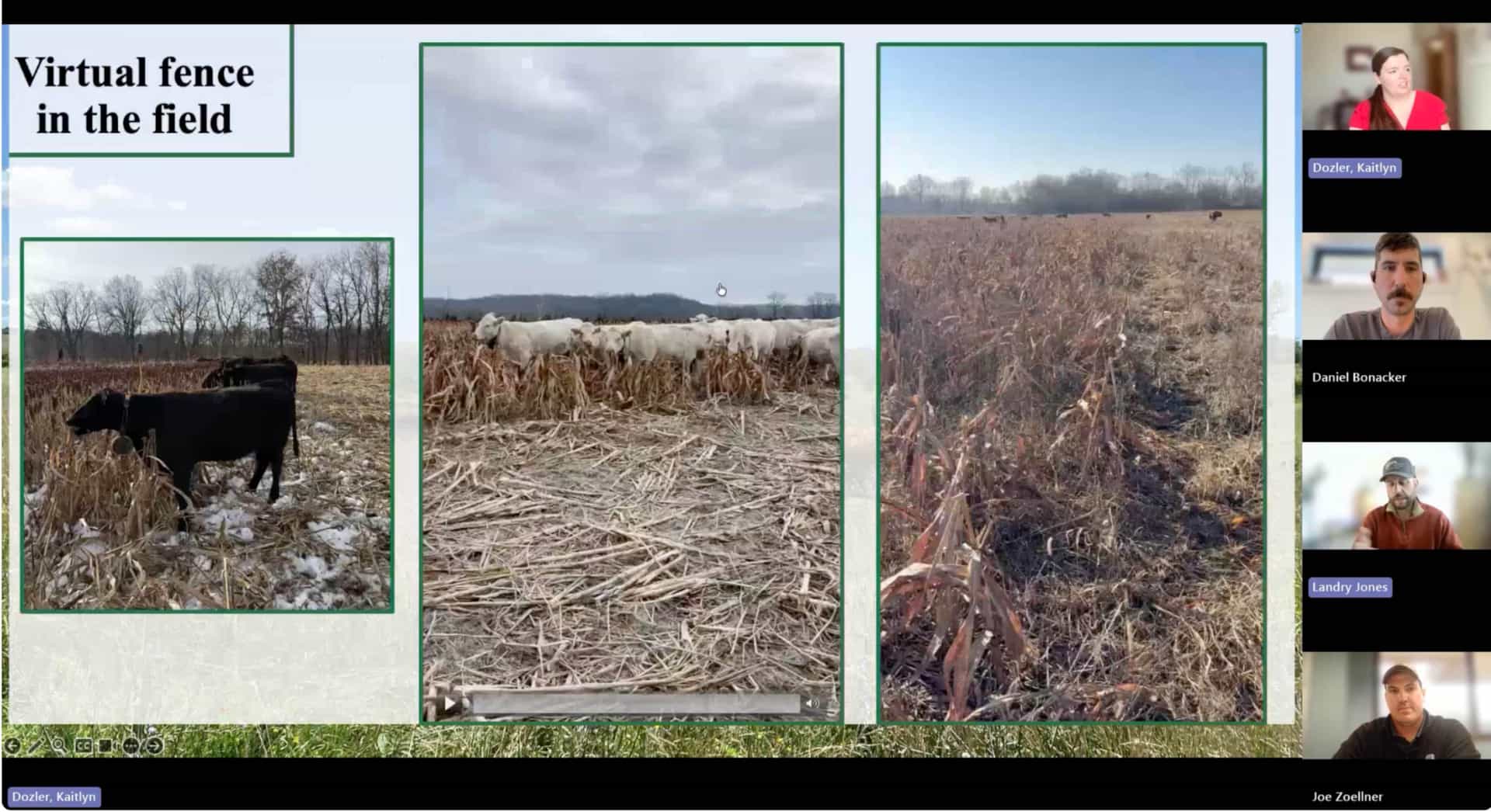
It is there. I mean that looks like that's a pretty hard line from kind of the grazed to ungrazed. Is that pretty typical like it is it, is it pretty, is it that straight in narrow?
Daniel Bonacker 42:23
Yeah, yeah, that's something I've been really impressed with is the accuracy of these things. It it looks like a straight line you you from a poly wire, right? It's just as straight as can be. Gallagher had said that the accuracy was 10.
Landry Jones 42:32
Yeah.
Daniel Bonacker 42:39
10 foot plus minus. It's far more accurate than that from my experience. I mean I I grazed Milo this winter, which is some some very high density grazing and that kept that line perfect.
Across that Milo. So Yep, pretty typical.
Landry Jones 42:59
Well, I think, yeah, and that kind of goes.
Dozler, Kaitlyn 43:02
There's your line, Dan, right there.
Daniel Bonacker 43:05
Yep.
Landry Jones 43:06
Yeah, there you go. That's crazy. And that kind of brings up another point there though, is like, I don't have Milo degrades where I'm at down here in Southwest Missouri, but I can imagine trying to string a poly wire through that stuff in the winter time with snow and ice and, you know, the interference of the.
Daniel Bonacker 43:09
Mhm.
Landry Jones 43:26
Stock.
And everything can be could be a nightmare like that would that would deter me from trying to do to do daily moves or you know like I would I'd want to just give them a week's worth so I didn't have to move that that Dang fence every day. And so I think something like this obviously is a remedy to that situation and not only this and and then you can talk about this more and how you're applying it but.
Daniel Bonacker 43:29
Yep.
Yeah.
Landry Jones 43:46
Because I've I've seen some slides from Titan's presentation before, but you know, giving this the ability not only to to increase our utilization of forges, but also put fences where we may have not had fences in the past to utilize another watering source or give them access to shade.
close to a river or Creek maybe, but we didn't have really fence there to begin with or it was barbed wire. Now we have the ability to to give them some shade or give them access to water that we didn't have before. So I guess maybe kind of talk about how you're utilizing, you know from that standpoint in your operation, are there are there areas that you're using this fence?
Outside of areas that you have typically grazed in the past because you didn't have that infrastructure in place.
Daniel Bonacker 44:30
Yes and no. Yeah, you're kind of only limited by your imagination, right? But one thing that the Center for Region wanted to look at was how to use these on crop ground, which I already have perimeter fence on this crop ground, so I've been grazing it previously, but it was.
Like you hit on there, Landry, where I'm getting more utilization out of that real crack ground instead of maybe just giving them a week's worth at a time, right? And the dead of winter when the ground's frozen, you can't put step in posts in I'm I'm.
Landry Jones 44:59
Mhm.
DanielBonacker 45:01
That that part has changed, right? I'm able to maintain high levels, high levels of utilization, even though I'm, you know, maybe don't want to bundle up and go out there and drill holes in the ground with the masonry bit so I can get step in post in, right? It's like it doesn't have to be that hard anymore. I had grades.
Landry Jones 45:20
Right.
Daniel Bonacker 45:21
I grazed Milo the last two winters the the old school way I guess you could say with with poly wire on reels and this past winter with the collars it was kind of like being on vacation. It was. I didn't know what to do with myself but.
You know, that would take, that would take a couple hours in the morning, every morning, especially when it's frozen to move that fence and with the collars, it was just so much easier. And yeah, I think looking at the, you know, kind of getting creative with watering points and things.
One thing I had done on a rental farm that it has some frost free waters on it. Yeah, Kaitlyn should have a picture.
Dozler, Kaitlyn 46:05
I was like, I have this one is I was like.
Daniel Bonacker 46:06
Yeah. So there are some watering points on it, but there is a good Creek that runs through there and being a rental farm, I don't have fence to exclude them from the Creek or you know, different things like that. Not a lot of infrastructure there. But what I was able to do, I could water them out of the Creek with the collars and I would limit.
Their access to the Creek, kind of to the best spot, maybe where they weren't tearing up like a steep bank or something. And then I could move that access point kind of down the Creek every few days. So they didn't beat up on one spot, you know, that would kind of move.
And I mean, you can go back and look and it's it's, you know, I still have a forage in place right up to the water and stuff. You know, they didn't turn it into a mud hole or anything because I I was really able to limit their access with the collars. Not an easy thing to do with posts, especially in in, you know, gravelly creeks, right?
So that was pretty neat. Again, something I didn't think about when we collared in September. These things just sort of come to you as you're as you're grazing. Just again, you're you're kind of stuck in the.
Landry Jones 47:00
Mhm.
Daniel Bonacker 47:15
You know, maybe in the paradigm of of physical fence, right? And sometimes it's hard to hard to think outside the box. But once you get into this, these virtual fence collars start to realize how how differently they can be used. It's I'm sure I've got a lot more to learn, a lot more scenarios to to play these things.
Things out, but that's that's a couple examples. One more would be this river we're on has a pretty bad habit of flooding and flooding pretty frequently. A lot of my pastures are.
You know down along the river and so obviously when the river gets up the electric fences is is no more usually wipes out certain spots and so I had the cows in a spot where there one border of the of the permanent fence was went underwater and so.
I had the Peace of Mind of just drawing a boundary that contained that group of cows. And when the floodwaters receded overnight, I didn't have to worry about them finding that hole in the fence. You know, I I slept easy that night. And then, you know, once the floodwaters went down, I'd go fix that fence. But those cows were still contained.
That was kind of neat.
Landry Jones 48:31
Yeah, yeah, absolutely. Well, I think, you know, and I've heard again heard Kaitlyn talk about it, but I think being able to use these, these, this technology as exclusion zones, right. There's always places on our farm that we'd probably not like to see our cattle hang out, but due to our infrastructure, we just can't do that whether it's a Creek bottom or a sensitive.
Daniel Bonacker 48:45
Mhm.
Landry Jones 48:50
You know, areas or whatever it might be. And so yeah, I think just just not only having the ability to keep animals in with with this technology, but also having the ability to keep animals out of areas that we don't want them for whatever reasons.
Daniel Bonacker 48:51
Yeah.
Yeah.
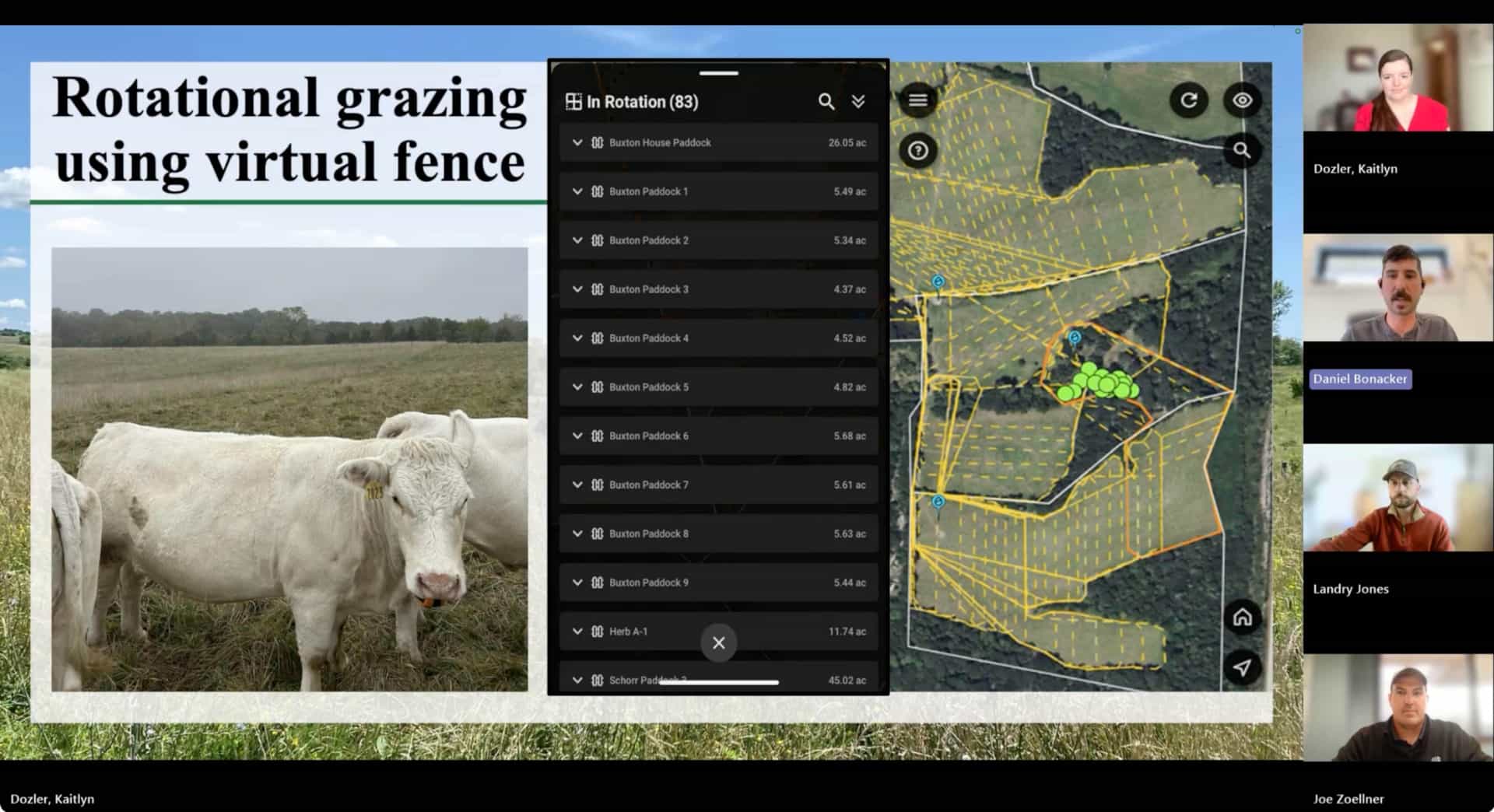
That's like this rental farm you can see here on the right of the screen. There's some a few permanent fences on it and I would pull poly wire with a solar charger in some places to manage my grazing. But a lot of times it was difficult for me to exclude them out of that timber there on the north side of the.
The field there, you can see where that that boundary was drawn around the timber. I had never done that before on that farm, just don't have any fence in place there. And so yeah, the exclusion zones, that's a big one.
Landry Jones 49:32
Yeah, yeah, absolutely.
Dozler, Kaitlyn 49:35
I was like, Dan, can you talk to them a little bit like about how you've gone away from just like the perfect squares and stuff like that? Like I feel like when people think about rotational grazing, it's like a perfect box or even like how you do the alley to like move the cows across the pasture and stuff like that.
Daniel Bonacker 49:42
Mhm.
Yep.
Yep. Again, that's that paradigm of a physical fence that, you know, I still have in my head. I'm sure a lot of producers will have in their head. Everything kind of has to be straight. It's hard to hard to do too many curves and and things. But yeah, especially like starting out in a in a.
New paddock or where new water sources. A lot of times you kind of give up maybe some area because you have to keep it straight with a physical fence. You can get kind of creative and make a like a circle around that first watering point, right? And and just things like that. I mean, again, you're only limited by your imagination.
Yeah, I've I've gently moved them and I I want to emphasize gently because you can't really push them too hard. But without a, you know, they don't have this visual cue of offence, right? So you can't really blame them for taking off and running through the boundary you drew. You know where you drew the.
Boundary, but they they don't know till they hear that tone. And so I I've gently moved the cow groups a couple times by drawing some lanes across the farm, pretty wide lanes, probably wider than I would with poly wire and then just sort of let them naturally move up to the catch pen.
And then I did that one time over kind of a couple day period and I had drawn some back fences in that lane. So as they came up to the catch pen, I put a back fence up and it was just kind of a natural low stress way of of moving them up up toward the catch pen. But it worked really well.
I didn't have to, you know, it would have taken me hours of putting up some temporary fence to to build those lanes and get them up close on that 100 acre farm, get them up close to the catcher pin. So that was that was pretty fun actually.
Landry Jones 51:37
Yeah, well in.
Yeah and and you know and and just thinking that through again kind of own operation or or even somebody else's. But you know we if if you knew that you were going to see work calves or or do some do some work to the animals you need them you know in the shooter in the crowd as you know.
Next weekend or two weeks from now and they were on the backside of the farm instead of either trying to do that manually the day of, you know, having that ability to to gently push those animals up towards maybe the catch pen or to an area that you could then put get them into the crowd. I mean that that would say.
Daniel Bonacker 51:59
Mhm.
Landry Jones 52:16
Save a lot of time, especially out West. I can imagine for folks that might be listed in this that have hard expanses of of acreage in their fields or you know, their fields are 600 acres in size. Just having that ability to to be able to crowd those animals and know where your animals are at, making sure that you've got them all. There's there's just so many things.
52:27
Mhm.
Daniel Bonacker 52:27
Mhm.
Landry Jones 52:36
I think this stuff could do not only from just forge utilization standpoint, but just operational standpoint.
Daniel Bonacker 52:44
Yep, Yep. If you, you know, you a lot of people express concerns over animal husbandry with these, but if you go into it with that in your mind that this is a tool that can be used with animal husbandry practices.
Landry Jones 52:45
Yep.
Daniel Bonacker 53:00
But that's where things really start to happen, I think. I think it could only amplify that if you use it in the right way.
Yeah.
Dozler, Kaitlyn 53:06
Yeah, and that's why training is such a big key. Like on average, they say training takes five to seven days. I'd say that's very standard. Some cows learn it way faster, some cows struggle with it more. And I've heard of scenarios where producers have just pulled a cow from a herd cause she just can't quite wrap her head around what she's trying to learn.
Daniel Bonacker 53:12
Yeah.
Dozler, Kaitlyn 53:24
In situations like that. But yeah, the first couple times they hear that sound or get that shocked, you're gonna get a pretty funny reaction out of that cow. But she picks up on it really fast, and that's the big key component to it. They have to be trained and you have to teach them how to respond to make the system work really successfully.
Daniel Bonacker 53:33
Mhm.
Joe Zoellner 53:44
What are you? Are you seeing about the same length of training in the small ruminants, Kaitlyn?
Landry Jones 53:44
Yeah.
Dozler, Kaitlyn 53:49
Yeah, I would say that five to seven day period is pretty standard across the board for the majority of the livestock that I've worked with.
Joe Zoellner 53:56
I see.
Landry Jones 54:00
When that was the question I was gonna ask you, I didn't think we covered is kind of what that time frame is on on how that works and and if I remember correctly, Kaitlyn, correct me if I'm wrong, essentially that training process is is you know putting those animals in a hard boundary pasture paddock small enough that you know that that.
That they know where those boundaries are, drawing your perimeter, drawing your virtual fence around that, and then kind of overtime just shrinking that paddock down to include only the virtual fence as their as their boundaries. That kind of how that's done.
Dozler, Kaitlyn 54:30
Yep, exactly. Main like physically fenced area, virtual fence around the outside and then everyday just move one side of that virtual fence in closer and closer to about your pen is about half the original size. Just letting the livestock really start to associate those sound and shot cues with that physical barrier and that's the fastest way for.
Landry Jones 54:32
Good.
Dozler, Kaitlyn 54:49
Them to learn.
Landry Jones 54:51
OK, Dan, was that kind of how long did it take your animals to you felt comfortable rolling them out into to an area?
Daniel Bonacker 54:59
Yeah, I think it was about 5 days and it it went, it went just like that. I had them in permanent paddocks and and shrunk those. I I actually was cutting corners off so there was kind of more of a rounded boundary that way they.
Landry Jones 55:01
OK.
OK.
Daniel Bonacker 55:14
Yeah, I didn't want them to get up into a corner of a permanent fence, 90 degrees to a virtual paddock and kind of confuse them, right? So.
Landry Jones 55:24
Mhm.
Mhm.
Daniel Bonacker 55:26
Again, you don't have to deal. You don't have to deal in straight lines here.
Dozler, Kaitlyn 55:26
Yeah, that's.
Yeah, that's a really good point. When it comes to the cows and virtual fence, always go more room versus less room when especially like around water points when it comes to training, no angles smaller than 90 degrees. You have to make the system like make it easy to understand for the cows.
Daniel Bonacker 55:46
And you can kind of see in this photo and the the light dashed lines is some of the old boundaries. If you look, a lot of them are got curved corners and things.
Landry Jones 55:48
So.
Mm-hmm.
OK. The only other thing that I really had here to discuss and it it may not take that long and Kaitlyn, you can you can just talk about it as in depth as you feel comfortable talking about it, but it's cost, you know, I know that.
It's it's not a cheap endeavor to to adopt virtual fences and and I know every company is going to be a little bit different right on what their price point is and probably and we don't need to go into every company and their structure and and how all that but what can folks kind of expect to pay on average for this technology and then.
Is there anything out there to help producers maybe offset the cost of of this technology if they're willing to adapt it?
Dozler, Kaitlyn 56:40
Yeah, definitely. So cost is by far the biggest barrier for producers coming into the technology. A lot of producers have plans in place, they're ready to use it, they want to use it. And then the price tag is kind of what stops them in their tracks.
On average, I would say a producer is going to pay anywhere from like $250 to $350.00 per collar per animal. There's two different ways the pricing structures work. So the majority of companies, a producer pays upfront for that collar and that's where you see that on average 250 to.
$350 per caller come into place. Some companies you don't pay anything upfront for the caller, but you pay a higher like annual subscription fee. And so for the company that does that, you're looking at roughly $72 per caller per year type of a situation. What then you have to start in.
Incorporating is like I call it like the data fees. So every company you're either gonna pay a monthly or a yearly data fee. On average that ranges from $1.50 to $2.00 like per animal per month or you're looking at roughly $45.00 per animal per year is what you're gonna expect for that.
Landry Jones 57:38
Hm.
Dozler, Kaitlyn 57:54
And so between the upfront cost of the callers and then kind of those yearly data fees, those are the two biggest cost components. The other ones are like if you do go with a company that requires a base station, those base stations can run anywhere from $4000 apiece all the way. The most expensive is $10,000 apiece.
And so depending on the number of base stations you potentially need, that can also kind of play into those price factors as well. There are programs in place. Missouri NRCS rolled out a virtual fence cost share program this last year. Producers can apply to be a part of that year round and then they'll hear about it if they were accepted during.
Like the batching periods and it's a really competitive program and they're offering a really great.
Cost share that I was like I lost the word in my head. Cost share option for producers. The producers would get it would be a five-year program. The producers would get a certain amount of money per caller per year to start with and then they would also receive a base payment to go towards the cost of a tower or covering the cost of.
Landry Jones 58:46
Yeah.
Dozler, Kaitlyn 59:01
Those cellular collars the rest of the way and then years two through 5, they would receive a payment per year per collar essentially to help a producer cover those costs and doing the math kind of on my end, just like roughly it would cover a lot of those costs for producers. So I'm really excited to see that project roll out.
Soil and water conservation districts in Missouri have talked about getting a program started. Not sure where they're at with that, but it has just been kind of brought up to me. The center is looking at potential options to help cost share producers. We're not sure exactly what that's going to look like, but we're hoping to hopefully get something in place.
Here in the next little bit to do that, but there are options out there. Every U.S. state should have the equip program up and running. It's been approved nationally. Whether it's starting on a state level, that's more state based what year that's going to start. And so I just encourage folks, yeah, talk to your local NRCS offices.
There's typically grants and other different things out there for producers as well. The more popular the technology gets, the more we're going to start to see those cost share options open up.
Landry Jones 1:00:04
Yeah. No, I think that's that's, I think it's great that they're they're offering that as as part of their EQIP program and and you know from a conservation planning standpoint that only in my opinion would make it easier for for them because I I would assume there's probably from a documentation standpoint at the end of the year, you know they want to know.
Dozler, Kaitlyn 1:00:18
Mm.
Landry Jones 1:00:24
What your was in the history and and the documentation that you have to prove that you were moving animals like you said you were going to move them and giving it the rest that you said you were going to get. And so I would I would assume this is probably just kind of a click of a few buttons and you could probably send some sort of a spreadsheet or or you know some sort of.
The document to them to to help make sure that you're in compliance with their program, so.
Dozler, Kaitlyn 1:00:49
Oh yeah, super easily. There's even like track features on some of the collars. So you can select like your whole herd or you can select one cow and you can go back and it'll show you the exact points that she was at in the pasture like throughout the day or over the last two weeks or anything like that. Like it is high tech tracking what your cattle are.
Landry Jones 1:01:02
You.
Dozler, Kaitlyn 1:01:09
Doing with these collars, it is really cool information to see.
Landry Jones 1:01:14
Yeah, yeah, that is cool. And I guess that kind of leads me and this is probably my last question that I have for for you, for both of you is where do you see this? Maybe this is a two-part question. One would be, I would assume with with any new technology, it seems like it evolves fairly rapidly, right? When when TV went to flat screens, it was plasma.
And then LCD, you know, at some point it just revolves so fast, it's is it, is it worth jumping in now or waiting until they kind of get everything worked out before a producer jumps in and that maybe that's not a concern, maybe maybe the technology is not going to change the infrastructure that you have in place.
Is not going to change. They're just maybe software updates or something like that. But I guess and Dan, if you're familiar with this, but Kaitlyn, where do you see the technology going? What's the kind of the next steps? And I think it's weird to say that the next steps because it seems like it's just shown up in in United States here, but.
You know, it just revolves, evolves so fast. Where's where's kind of the next step for for these technologies for these companies?
Please.
Dozler, Kaitlyn 1:02:15
I would say definitely the animal health standpoint of things like calving detection alerts, heat detection alerts, just kind of more deep diving into like the movement of cattle and potentially being able to look at like their movements and like when they move, how much they move to determine like if an animal's possibly becoming sick or different things like that.
A lot of those big animal health components, that's a really big thing that I would say all the companies are kind of racing towards right now. And it's not like an if it's gonna happen, it's more like a when it's gonna happen. I wouldn't be surprised by the end of the year if we see a lot of those animal health updates. There's also talk a lot of the companies talk about going to fully satellite based collars and.
Landry Jones 1:02:54
Hmm.
Dozler, Kaitlyn 1:02:54
Getting rid of a cell, like the need for cell service or the need for a tower in general. And so that's another potential update I could see coming in the future. We might see some collar redesigns. I don't think it would be anything crazy from that standpoint, I mean.
Otherwise, a lot of the updates that I think the systems would end up getting would be software updates would be my hope at least. So that way it would be just updating the software and that way a producer that might have already purchased the technology wouldn't have to go out and buy new collars or something like that. Or if that was the case, I would hope there would be some sort of buyback.
Landry Jones 1:03:17
Right.
Dozler, Kaitlyn 1:03:30
Grammar. Something like that. But that's that's the big question mark. They don't tell me all their secrets, unfortunately, but I try.
Landry Jones 1:03:37
Yeah, right.
All right. Well, I I think that's really about all I had. I don't know if, Joe, if you had anything else or if you guys, if there was anything that I missed, Dan or or Kaitlyn, that you wanted to discuss. But now's the time to do that if you'd like.
Joe Zoellner 1:03:52
No, really the only two things I had left that we hadn't checked off were the training and the, you know, kind of the future advancements. And I think we've covered those. Maybe Kaitlyn or Dan, can you speak to, you know, back to animal husbandry and safety?
You know, even if an animal get hung up in a fence or some brush or something, you know there's these collars are designed to break off under a certain force and.
Dozler, Kaitlyn 1:04:21
Dan, do you wanna take that or do you want me to?
Daniel Bonacker 1:04:23
Yeah, well, just kind of what you told me, Kaitlyn, I know they're they're designed to break under a certain amount of force. I haven't had any break yet. But yeah, I I suppose I'm just trusting that the company has those in place because I can see it be a problem, so.
Dozler, Kaitlyn 1:04:25
OK.
I've seen it happen a couple of times where something's gotten hung up and the collar, they've applied enough pressure and the collar's broke like at a breaking point to let that animal be free. There's also the animal safety alerts in place as kind of another backup safety. So like if a.
Cow gets stuck in the Creek or something, or a cow breaks her leg, or if a collar falls off. Unfortunately, you'll get a notification that the collar hasn't moved or the cow hasn't moved in a while and it'll show up as like an alert on your phone. It'll be like go check cow 243 type of a situation. And so they also have those like safety aspects in place too.
With the collars.
Daniel Bonacker 1:05:17
On the on the flip side of that with the collars falling off, I've been curious how durable they are going to be in the the hold up, you know, you know you got cows rubbing on trees and things that's just sort of in their nature or you know they're hitting it on the on the water and things. And so I've been kind of curious how the durability of these things.
Are going to be and obviously we're going to learn a lot more as time goes on. The project's three years long. So that's that's one that maybe before because I personally want to purchase some more collars to continue to collar more of the herd. But that's probably where personally I'm going to wait and kind of see maybe at the end of three years.
Where durability fell among the companies because a lot of these I think are warranted for what, three years or so? Yeah. And So what is what does the collar look like in three years? And I think that's maybe where I'm going to put a lot of judgment on before purchasing some some collars of my own.
Dozler, Kaitlyn 1:06:05
Three to four, yeah.
Landry Jones 1:06:18
Right. Yeah. Well, and I can. I mean, I I gotta believe that.
One of the biggest maybe not issues, but one of the things that I would want to look at is is you know I like I think there's some companies that maybe don't have a solar charger solar panel on the on the collar and so you're you potentially have to replace that battery whenever it died the fact of just having to get animals up to.
Change collars out or to fix the collar or to put new ones on them, I think is would be the biggest headache of this whole system if that's if that happens on a fairly consistent basis, right. We've got those animals up, you know, a couple times, three times ways to to work them to do whatever we need to do to them. But if if you got one animal that you got to split off from the herd.
Because her collar broke or whatever it might be, if you have to do that on a pretty regular basis, that's going to get, that's going to get frustrating. So yeah, durability would be a huge thing for sure.
Dozler, Kaitlyn 1:07:11
Yep.
Definitely. And just, yeah, you. I think that's where you almost do a little bit trade off of Labor. You might not be out there putting up fences and stuff like that all the time, but you really want to monitor what those collars are looking like on the necks of those animals. You don't want to get a situation where it's too tight and something's rubbing. Just, yeah, be out there. Another good reason.
Daniel Bonacker 1:07:14
Mhm.
Dozler, Kaitlyn 1:07:33
And yeah, be boots on the ground, be vigilant out there with your cows and kind of watching for stuff like that.
Daniel Bonacker 1:07:37
Yeah, that's a great point. It's a trade off of Labor for sure. Yep, great point.
Dozler, Kaitlyn 1:07:41
Mhm.
Landry Jones 1:07:43
Yeah.
Joe Zoellner 1:07:45
Then Kaitlyn, yes, go ahead. Just one of the last things. You've obviously been kind of doing the virtual fence tour the last few months or there. I know we're going to have you at our for our and soil health field day the end of June.
Landry Jones 1:07:46
All right. Well, that's. Go ahead, Joe.
Joe Zoellner 1:08:03
But for those folks who haven't seen Kaitlyn or Dan in person yet, you know it's a great opportunity to hear their.
Aspects face to face. Ask some good questions. Kaitlyn, I know a lot of times you have the callers on hand where attendees can actually get hands on the callers and see the technology themselves. Do you have any events coming up that you want to get on folks radar in the near future or?
Dozler, Kaitlyn 1:08:28
Yeah, that's that's actually a great reminder. Thank you. There's gonna be a virtual fence field day kind of coming up at Columbia or at the university. It's probably at the University of Missouri South Farm. Well, I'm gonna, I'm gonna step back on that. It's gonna be somewhere around Columbia. All of the details haven't been worked out yet.
Joe Zoellner 1:08:29
For those.
Dozler, Kaitlyn 1:08:48
Whereas.
Looking at June 25th is the time frame right now and we'll kind of work that out and send those details out to the public. But that's going to be a really great opportunity. We're going to hopefully have all of the companies there to talk about their products, get all the producers there in person and really kind of show off what we've been doing the last year about year and a half, some of the research projects.
Up and coming with it and give producers a really good chance to kind of see the technology in action and hear about it from producers using it first hand. And you don't have to go to an event to call and ask or to ask questions or kind of see the technology work. That's one of the pros of having Dan and the other private producers and the other university research farms is I get to.
Give out their cell phone numbers and people get to go out to their houses and kind of see the callers in action and stuff like that. And so people can always call and e-mail me and I'm happy to get them set up to go see at work in the field and answer any questions they have.
Landry Jones 1:09:44
Cool. Yeah. Yeah. They may want to call Dan ahead of time if they're gonna show up. Just make sure it's not 10:00 at night. Yeah. Yeah. Give them a heads up. No. Yeah. Yeah. No, that's great. Shameless plug for for our event and and for.
Daniel Bonacker 1:09:48
Yeah, I appreciate it.
Dozler, Kaitlyn 1:09:48
Yes.
Yeah, we we get it. Yeah, we get it set up.
Daniel Bonacker 1:09:52
Mhm.
Landry Jones 1:10:00
For University of Missouri's as well, so.
Dozler, Kaitlyn 1:10:02
Yeah, I'll get that information over to you guys when we have it all set in stone.
Landry Jones 1:10:07
Great.
All right. Well, folks, if that's it, unless anybody has anything else, I think we'll we'll kind of wrap this one up. I I really appreciate both of you being here today. Dan and Kaitlyn, I I know you guys got a lot of things going on right now. So I appreciate your time joining us and and appreciate everyone listening today. Until then, we'll catch you on the next one.
Daniel Bonacker 1:10:30
Sounds good. Thanks for having us.
Dozler, Kaitlyn 1:10:30
Sounds great. Thank you.
Joe Zoellner 1:10:32
Nice.