New season, same goal
by Emily Kummerfeld
MFA Research Agronomist Trace Thompson shares the philosophy guiding MFA’s field studies
Agronomy research isn’t for the faint of heart.
Beyond the monotony of scientific procedure and the analysis of mountains of data, an agronomist faces the challenges inherent to agriculture itself: unpredictable weather, rapidly evolving technology and volatile market conditions.
“I believe the biggest skill future agronomists need is just learning how to adapt,” said Trace Thompson, research agronomist at MFA Incorporated. “They’re going to constantly have to know how to adjust their programs and what they’re doing for an ever-changing environment.”
Thompson, who joined MFA in January, is ready for the task. A University of Missouri graduate, he earned a bachelor’s degree in plant science with an emphasis in crop management, followed by a master’s in plant, insect and microbial sciences. After graduation, he worked at Mizzou as a senior research associate, overseeing Dr. Kevin Bradley’s field research program.
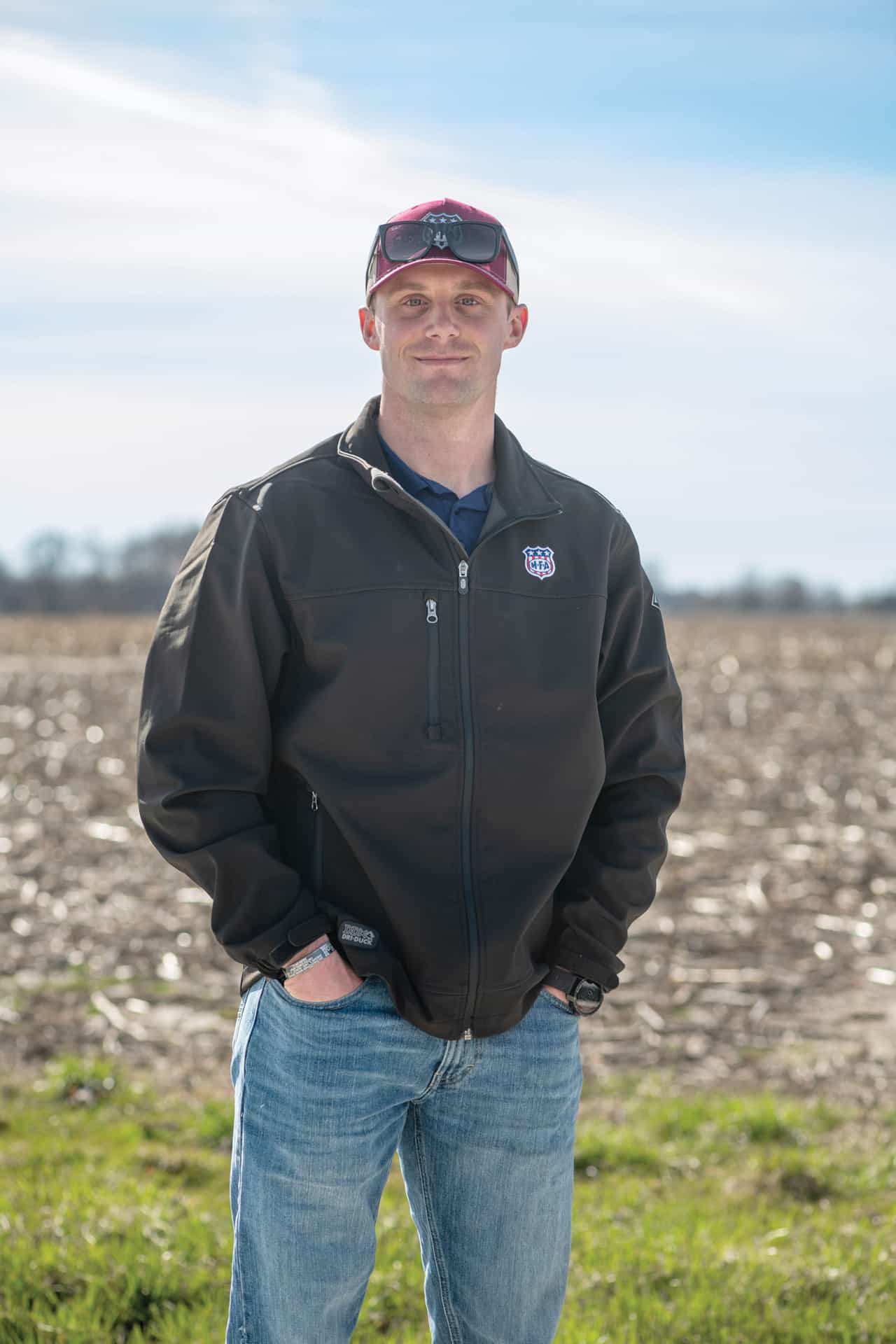 Thompson’s love of agronomy took root long before college. “I just grew up around it,” he said. A native of the rich agricultural region of Howard County, Mo., Thompson now lives in Fayette with his wife, Alyssa, and daughter, Charlee, age 6 months.
Farming runs in the family. His father, Joe, was raised on a hog farm, and his brother, Cody, is a row-crop farmer. But Thompson credits a family friend and agronomist, Nick Monnig, as the mentor who steered him toward graduate school and a career in agronomy research. In fact, he didn’t decide to attend graduate school until his last semester of undergraduate studies.
“I didn’t know anything about research till grad school,” he recalled. “Nick told me about it, so I decided to go, and then ended up liking it a lot.”
A big part of that appeal, Thompson said, comes from the work’s hands-on nature. “In the summer, we’re outside all day, every day,” he said. “I like just being outside, doing stuff with my hands, and seeing these things we talk about.”
In graduate school, Thompson’s personal research focused on weed science and herbicides, with his thesis project studying how drones could be used to apply herbicides. But over time, he realized he wanted to work in a broader field, which drew him to MFA’s research program.
“I like the diversity here at MFA,” he said. “We are experiencing a lot of different things, not just focused on biologicals, herbicides or other products. We also like to look at application methods and farming practices.”
With the arrival of spring, Thompson is ready to dive into this season’s research trials. MFA’s agronomy team operates 14 large-plot trial sites, with seven corn and seven soybean locations across the state. After planting, the team’s focus will shift to the two research farms in central Missouri, which host small-plot trials, Thompson explained.
“That’s where some of our detailed trials happen with products such as biostimulants, herbicides, nutrient-use efficiency studies and short-statured corn,” he said.
Along with traditional corn hybrid and soybean variety trials, this year’s research will include a look at the new Vyconic soybeans from Bayer, the first trait technology with a five-herbicide tolerance: dicamba, glufosinate, glyphosate, 2,4-D, and mesotrione (HPPD). In other new studies, the agronomy team will be testing nitrogen stabilizers, including Koch’s Centuro, and upcoming products such as BASF’s pre-emergent herbicide Voraxor; Syngenta’s soybean and cotton seed treatments, Victrato; and Rapidicil, a PPO-inhibiting herbicide ideal for no-till systems, marketed by Valent.
Managing multiple trials at once doesn’t faze Thompson. His priorities for this first year with MFA are simple:
“First and foremost, the priority is organization and execution—making sure that everything’s laid out properly, all our data is accounted for, and that everything is completed properly,” he said. “And then, as always, learn as we’re doing it.”
But, just as importantly, Thompson said, it’s imperative to remember who the research serves.
“Second is that everything we’re doing is practical and applicable to today’s farmer,” he said. “It doesn’t take away from their normal programs, and it’s not an additional thing they have to do. It’s affordable, and they’re getting a return on investment with what they’re doing.”
With today’s high input costs, making that priority a reality is Thompson’s biggest challenge. “You can do a lot of things that will increase yield, but it doesn’t mean they’re going to make more money doing it,” he said. To keep research practical and cost-effective, Thompson asks a few fundamental questions before any fieldwork begins.
“One, are we answering current farmer questions? Maybe not always what I want to know, but what are our producers asking us to do?” he said. “For question two, is it practical—either now or in the future—and will it ever make its way out onto the market? And three, are we being good stewards? Is what we’re doing taking care of our soils and environment?”
Putting producers first is built into the cooperative model. Because MFA’s member-owners are also its customers, every trial and research goal is aimed at helping producers succeed—not just boosting company revenue. Thompson said that this shared focus gives the research credibility and allows the outcome of trials to be viewed objectively.
“Non-biased research is very important,” he said. “We don’t care if it works or not. If it works, we potentially want to sell it. If it doesn’t, we won’t. We don’t have a dog in the fight when we’re doing it. Producers see exactly what I see—I’m not altering anything to favor their viewpoint or the company selling the product.”
That same commitment drives his vision for what’s ahead in MFA’s agronomic research program, both this season and years to come. One area the team is investigating is sustainable ways to boost productivity. Future trials could test variable-rate residual applications based on soil type, with soils higher in organic matter receiving a higher rate. “That’s a way to hopefully cut back on herbicide costs,” Thompson said.
Other trials may explore products that have a high nutrient-use efficiency and require less fertilizer.
And while agronomy research will always promise painstaking attention to detail, blistering summer heat and industry forces beyond his control, Thompson said the quest for knowledge makes it worthwhile.
“We put trials out, and we’re like, ‘I kind of expect to see this and this,’” he said. “But then sometimes it’s not what you expected. And figuring out the why of something I didn’t expect to happen, solving that puzzle, is probably my favorite part.”
CAPTIONS – Top photo: A specialized plot planter is used to establish trials at MFA’s research farms, including this 30-acre site east of Columbia, Mo. At these locations, the MFA agronomy team tests both corn and soybeans in many different ways, providing valuable insight to growers using Missouri-specific data. Portrait - Trace Thompson joined MFA in January as the new research agronomist. In this role, he will help lead the design, execution and analysis of MFA’s large- and small-plot trials across the state as well as studies at the company’s two research farms.
***
Read more in the April/May Today's Farmer magazine HERE.
Find more issues of Today's Farmer HERE at https://mfa-inc.com/todaysfarmer