History at work
Story and photos by Allison Jenkins
Local businessman Jimmy Zumwalt relocates, restores and reimagines vintage MFA building in Belle, Mo.
There was a time when the MFA feed mill in Belle, Mo., was a gathering place as much as a place of business.
Today, that history is still at work, just in a different location.
Rescued from the brink of demolition, the 1900s-era building is now serving as the offices for local businessman Jimmy Zumwalt and his wife, Wendy, who own Mid-State Pipeline Maintenance. In 2021, the Zumwalts moved the old mill about 1,000 feet across the road to a lot facing Highway 28 and spent the next three years renovating and repurposing the structure to not only house their company’s headquarters but also community gatherings.
“When the feed mill was in operation, all the farmers would meet there, sit around and tell stories, and a lot of the kids worked there through high school,” Zumwalt said. “And everybody got feed there because it was the only one in town. It had too much history to be destroyed.”
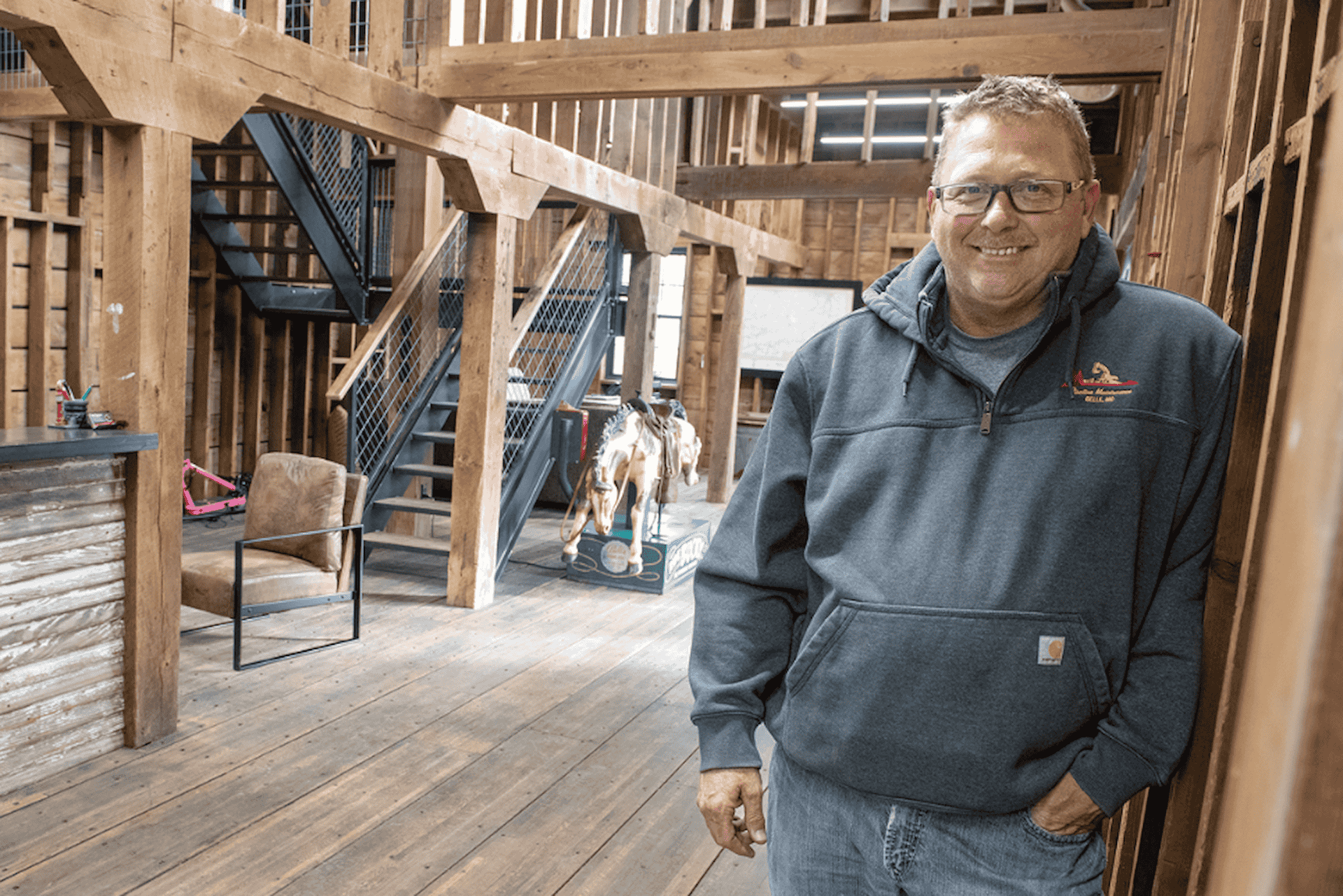 Zumwalt just happened to be looking for an unusual building to turn into an office when he found out the city of Belle planned to tear down the feed mill, which had been vacant for years. He had tried to save other historic structures before—part of the old brick factory in Mexico, Mo., and a vintage gas station on his property—but neither survived long enough to be restored. The Belle mill, though worn and weathered, still had potential.
“It was built between 1906 and 1909. That’s really all we know,” he said. “It was several other things over the years—a salvage store, for one. I believe MFA bought it in the mid‑1970s.”
Seeing an opportunity, Zumwalt offered to purchase and relocate the building rather than watch it be razed. He enlisted a house-moving company out of Dora, Mo., to slowly but surely remove the mill from its thick concrete foundation, elevate it on steel beams and transport and transfer the structure to its newly poured foundation. Then he left the building alone to settle for about a year to ensure structural stability.
That’s when the real work began. The restoration process involved multiple passes with a pressure washer to remove years of grime, feed dust and animal droppings. Zumwalt salvaged as much of the original tin exterior as possible and repurposed it on an interior wall. He replaced the siding with a shiny, modern-day version to keep the retro look.
The original mill measured 20 by 40 feet and stood 40 feet tall. Zumwalt doubled the footprint to 20 by 80 feet, adding offices, a commercial kitchen and a spacious meeting room used for both staff functions and public events.
“We’ve had birthday parties, class reunions, baby showers, things like that in here,” Zumwalt said. “We want this to belong to the community as much as it does us.”
Keeping the sturdy wooden skeleton of the building intact, he found other sources of architectural salvage to serve as flooring, walls, trusses and trim. For example, he created door frames from used power poles. An old metal hog feeder was transformed into a chandelier in the lobby. And the back wall of the meeting room is made of old barn wood he discovered in Kansas. The faded red boards serve as a canvas for many of the vintage storefront and marketing signs in Zumwalt’s extensive collection, most of which feature agricultural themes—including several with MFA advertising.
“We wanted a traditional backing for the signs that would allow each one to pop,” Zumwalt said. “We started collecting them after going to an auction about 14 years ago and buying an old pharmacy sign. We just thought it was cool. From there, it was game on. We’d pick up one here and there. We had them in our house before we ever started this project, but once we got this going, we had a place where we could keep adding to the collection.”
The main floor houses the lobby and staff offices, while Jimmy and Wendy have their own personalized offices on the second story. A narrow set of stairs leads to the third floor, where their younger sons claimed the space for reading and doing homework. Parts of the milling equipment remain in the small room on the uppermost level.
Other original mill artifacts were integrated as accents throughout the building. A section of the feed conveyor belt now holds artificial succulents in Zumwalt’s office, the iron‑bar door hangs between the offices and meeting room, and a reclaimed ladder and sliding wooden panel now decorate the meeting space.
“The devil is in the details,” Zumwalt said. “One thing led to another, and every day, it would evolve a little bit more.”
Once the office building was complete, Zumwalt didn’t rest for long. He and Wendy began thinking about how the project could add even more life to their small town, especially with Belle positioned along the developing route of the new Rock Island Trail State Park. Following an old railroad corridor, the section of the trail that runs through Belle is part of a 144-mile stretch still under construction that will eventually extend from Windsor to Beaufort, Mo.
Looking for other ways to draw visitors, Zumwalt decided to add a few extra attractions of his own. One is the “world’s largest cowbell,” which now hangs beside the renovated mill (see sidebar on page 29). He also acquired a Rock Island caboose from a friend in St. Louis who operated a rail maintenance company. Repainted in its authentic colors, the car now sits on a short section of track behind the feed mill office.
Still, the restored MFA building itself remains the centerpiece.
“It’s really neat, because so many people remember it from when they were kids,” Zumwalt said. “A lot of them will come in and say, ‘Oh, it still smells the same!’ and they’ll want to look around and go all the way to the top.”
When it came to creating a new home for his company’s offices, Zumwalt said a brand‑new building would have lacked the personality he was after.
“I wanted something different,” he said. “Anybody can build a new building. That’s boring. No matter what I’d done, there would be no depth to it. It wouldn’t have any history.”
For him, restoring the old mill was about more than saving a structure. It was also about investing in the place he’s always called home.
“I’ve been all over the world working but just never left here,” Zumwalt said. “Never needed to.”
Like many rural communities, Belle has faced the challenge of keeping businesses open and drawing people to stop rather than drive through. Zumwalt hopes projects like this can help shift that momentum.
“All these little towns are drying up,” he said. “I can’t fix everything. But we’re on the map now. If I can help stop the decline and give people who live here a little better quality of life—and bring in some tax revenue—we’ve won.”
He and Wendy are already working on restoring other properties in town, including a small gas station and the old bank building, while supporting projects like Belle’s new 29-acre sports complex, which features both indoor and outdoor facilities.
“We’ve got to have reasons for visitors to stop,” Zumwalt said. “Every time somebody stops here, they never just leave. They’ll get gas or eat somewhere in town or visit one of the shops. We aren’t going to change the world, but we can have fun doing it.”
VIEW THE ARTICLE AS PRINTED VIA FLIP BOOK - CLICK HERE -
***
Read more in the April/May Today's Farmer magazine HERE.
Find more issues of Today's Farmer HERE at https://mfa-inc.com/todaysfarmer